
Top 10 LiFePO4 Battery Manufacturers in China (2026)
Ranked guide to the best LiFePO4 battery manufacturers in China for 2026. Compare cell makers vs pack integrators, annual capacity, certifications (UL/CE/UN38.3), MOQ, and applications — solar storage, UPS, telecom, and EV.
Quick Answer: Who Are the Best LiFePO4 Battery Manufacturers in China?
Cell manufacturers (make the LFP cells themselves): CATL, BYD, EVE Energy, Gotion High-Tech, and CALB dominate global LiFePO4 cell production. These five companies control over 70% of China's LFP cell output.
Pack and system integrators (buy cells, build complete battery systems): NARADEX, Pylontech, Pylon, and dozens of specialized factories in Guangdong and Zhejiang assemble LFP cells into finished battery packs with BMS, enclosures, and certifications for specific applications — solar storage, UPS backup, telecom, and industrial use.
Why this distinction matters for buyers: If you need 100,000+ cells per month, you negotiate directly with cell makers. If you need 200-5,000 complete battery systems with custom voltage, BMS, and enclosure, you work with an integrator. Most international buyers fall into the second category.
*Last Updated: 2026-10-17*
Related reading: Lithium Battery OEM Manufacturer China: LFP vs NMC Guide
Cell Manufacturer vs Pack Integrator: The Critical Distinction
Before ranking individual companies, you need to understand the two fundamentally different types of LiFePO4 manufacturers in China. Confusing them is the most expensive mistake buyers make.
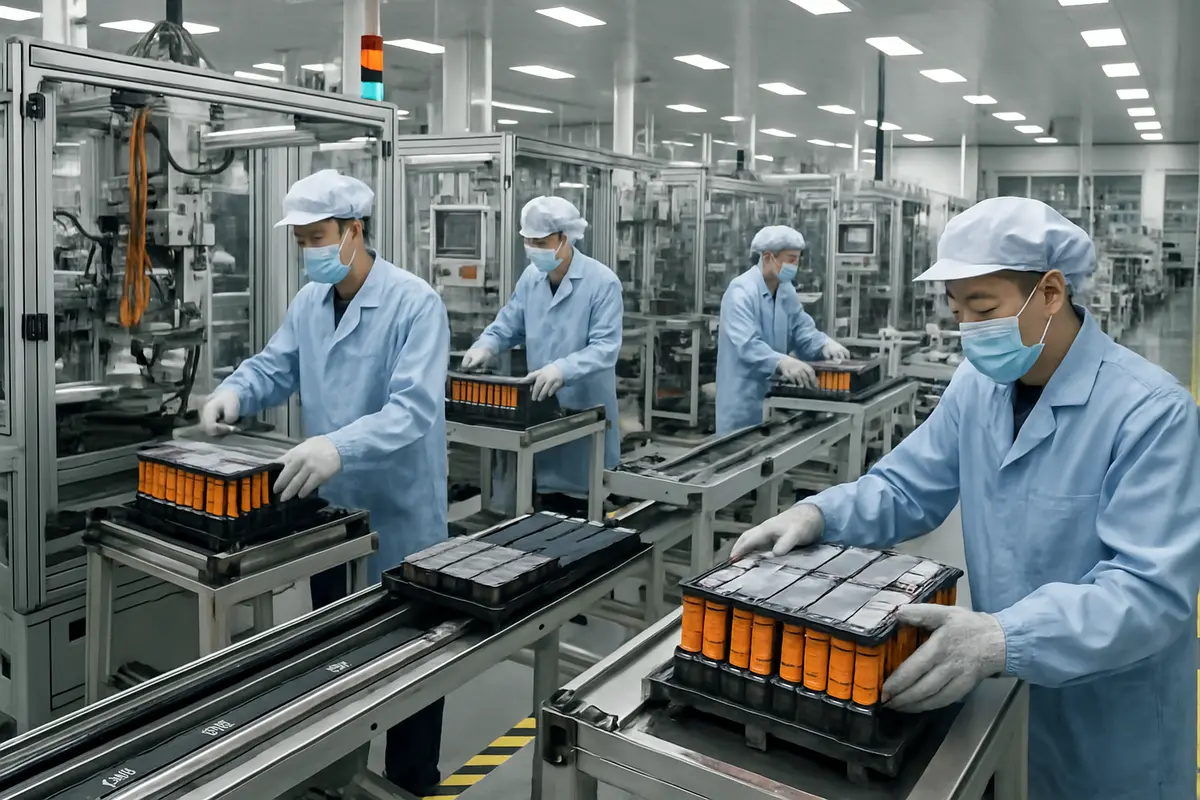
Cell manufacturers operate cathode material synthesis lines, electrode coating machines, cell assembly (winding or stacking), electrolyte filling, and formation/aging equipment. A single cell production line costs $50-200 million. These companies sell bare prismatic cells (like CATL's 280Ah or BYD's Blade cell) in quantities of 10,000+ pieces. They do not typically customize BMS firmware, build enclosures, or handle end-application engineering.
Pack and system integrators purchase cells from the companies above (or from second-tier cell makers) and engineer complete battery systems. This includes cell matching and grading, BMS design and programming, thermal management, enclosure design (IP65/IP67 for outdoor, 19-inch rack-mount for data centers), and application-specific certifications (UL 9540A for energy storage, IEC 62619 for industrial). Their MOQ is typically 200-500 units — accessible for most international buyers.
Key insight from our factory floor: A 48V 100Ah server rack battery contains 16 individual LFP cells, a multi-channel BMS with communication protocols (RS485/CAN/Modbus), a steel or aluminum enclosure, wiring harness, fuse, and connectors. The cells represent about 55-65% of the total cost. The remaining 35-45% is BMS, enclosure, assembly, testing, and certification. The integrator's value is in the engineering and quality control of that 35-45%.
Quick Comparison Table: Top 10 LiFePO4 Manufacturers
1. CATL (Contemporary Amperex Technology)
Type: Cell Manufacturer
CATL is the world's largest battery manufacturer by market share, holding approximately 37% of global EV battery shipments in 2025. Their LiFePO4 cell offerings include the standard 280Ah prismatic cell (widely used in energy storage), the 314Ah cell for grid-scale projects, and the 560Ah cell launched in late 2025 for utility-scale installations.
Strengths: - Unmatched production scale — over 100 GWh of LFP capacity across Ningde, Liyang, and overseas plants - Cell-to-Pack (CTP) technology eliminates modules, reducing system cost by 15-20% - Sodium-ion and condensed battery R&D pipeline for next-generation products - Global supply chain with plants planned in Germany, Hungary, and Indonesia
Considerations for buyers: - MOQ is extremely high — CATL sells cells to large OEMs and system integrators, not directly to small importers - Lead time can be 3-6 months for new customers - Premium pricing — 10-20% above second-tier cell makers
Best for: EV manufacturers, utility-scale storage developers (100 MWh+), and large system integrators who need the highest cell consistency and brand recognition.
2. BYD (Build Your Dreams)
Type: Vertically Integrated (Cell + Pack + System)
BYD manufactures everything from lithium ore processing to finished energy storage systems. Their Blade Battery (a long, thin LFP cell that passes the nail penetration test without thermal runaway) has become a benchmark for LFP safety. The BYD Battery-Box series for residential storage and the BYD Cube for commercial/industrial use are sold in 90+ countries.
Strengths: - Full vertical integration from raw material to finished system — lowest per-kWh cost in the industry - Blade Battery technology with class-leading safety performance - UL 9540A fire safety certification for North American energy storage market - Established distribution network across Europe, Australia, South America, and Middle East
Considerations for buyers: - BYD primarily sells finished products under their own brand — OEM/white-label options are limited - Minimum order is typically one container (about 500 kWh for residential units) - Less flexible for custom BMS or enclosure modifications
Best for: Solar installers and distributors who want a proven, brand-name residential or commercial storage system with global warranty support.
Comparing battery technologies for your project? See our detailed AGM vs Lithium-Ion Battery Comparison for UPS to understand when lead-acid still makes sense.
3. NARADEX
Type: Pack and System Integrator
NARADEX started as a VRLA (lead-acid) battery manufacturer specializing in AGM, GEL, and OPzV tubular gel batteries for UPS, telecom, and solar backup. With 10+ years of R&D in battery systems engineering, NARADEX expanded into LiFePO4 pack integration — applying deep expertise in BMS design, thermal management, and application-specific certification to lithium energy storage systems.
Strengths: - **Dual-technology expertise:** One of the few manufacturers offering both proven lead-acid AND LiFePO4 solutions — critical for buyers who need technology-neutral recommendations based on application requirements, not sales targets - CE, IEC 62619, UN38.3, and ISO 9001/14001/45001 certified - Custom BMS programming for specific applications (telecom 48V, UPS rack-mount, solar hybrid) - Accessible MOQ of 200 units — ideal for regional distributors and system integrators - 500 MWh annual pack assembly capacity at the Jiangmen facility - Factory-direct pricing with full engineering support (thermal simulation, string sizing, BMS configuration)
Considerations for buyers: - NARADEX does not manufacture LFP cells — they source A-grade cells from CATL, EVE, or CALB and focus on pack engineering and system integration - Best suited for orders of 200-10,000 units; for 50,000+ unit volumes, direct cell procurement may be more cost-effective
Best for: International distributors, telecom operators, solar installers, and UPS integrators who need a custom-engineered LiFePO4 battery system with responsive technical support, reasonable MOQ, and dual-chemistry expertise. Request a quote or view our full product range.
4. EVE Energy
Type: Cell Manufacturer
EVE Energy is the second-largest LFP cell manufacturer in China after CATL, specializing in large-format prismatic cells for energy storage. Their 280Ah and 314Ah LFP cells are among the most widely used by third-party pack integrators worldwide. EVE also supplies cylindrical cells (including 46-series large cylindrical) for power tools and EV applications.
Strengths: - Industry-standard 280Ah LFP cell used by hundreds of integrators globally — excellent for benchmarking - High cell consistency (capacity spread under 1.5% within batches) - Competitive pricing — typically 5-15% below CATL for equivalent specifications - Strong presence in energy storage segment with over 60 GWh annual LFP capacity
Considerations for buyers: - Cell-only supplier — no finished systems or BMS - MOQ typically 50,000+ cells for direct purchasing - Quality varies by production line vintage — request cells from newest lines for best consistency
Best for: Battery pack manufacturers and large system integrators who assemble their own products and need reliable, competitively-priced LFP cells in volume.
5. Gotion High-Tech (Guoxuan)
Type: Cell Manufacturer
Gotion High-Tech (Volkswagen holds a 26% stake) focuses on LFP and LMFP (lithium manganese iron phosphate) cells for EV and energy storage. Their Hefei and Nanjing factories produce 50+ GWh annually, with expansion targets of 100+ GWh by 2027. Gotion's LMFP cells deliver 15-20% higher energy density than standard LFP while maintaining similar safety characteristics.
Strengths: - Volkswagen partnership provides European market credibility and quality standards - LMFP next-generation chemistry with 210 Wh/kg (versus 160-175 Wh/kg for standard LFP) - Aggressive pricing strategy to gain market share - Plants under construction in Germany and the United States
Considerations for buyers: - Primarily focused on automotive OEM supply — energy storage is secondary - LMFP cells are still scaling and may have limited availability in 2026 - Direct purchasing requires significant volume commitments
Best for: Automotive OEMs and large energy storage developers seeking next-generation LFP/LMFP technology with European supply chain options.
6. CALB (China Aviation Lithium Battery)
Type: Cell Manufacturer
CALB produces LFP prismatic cells ranging from 100Ah to 560Ah for EV, energy storage, and marine applications. Originally focused on defense and aviation, CALB has expanded rapidly into commercial energy storage. Their L-series large cells (280Ah, 314Ah, 560Ah) compete directly with CATL and EVE in the utility storage market.
Strengths: - Aviation heritage drives rigorous quality control — cell failure rates below 2 PPM - Strong position in marine and heavy-duty applications (DNV-certified cells) - 50+ GWh annual capacity with major expansion underway in Chengdu and Portugal - Competitive pricing — 5-10% below CATL for similar cell specifications
Considerations for buyers: - Less established export distribution network compared to CATL or BYD - Cell-only supplier — does not offer finished pack or system solutions - Customer support for small/medium accounts can be slow
Best for: Marine battery system builders, large ESS integrators, and EV manufacturers who value quality control rigor and DNV certification for maritime applications.
Need help choosing between LFP chemistries? Read our LFP vs NMC vs LTO comparison with detailed specs, pricing, and application guidance.
7. Pylontech
Type: Pack and System Integrator
Pylontech is one of the most recognized Chinese LiFePO4 battery brands in the residential solar market, with the US2000/US3000/US5000 series installed in hundreds of thousands of homes across Europe, Australia, and South Africa. They purchase LFP cells from Chinese suppliers and engineer complete rack-mount or wall-mount battery modules with integrated BMS and communication interfaces.
Strengths: - Strong brand recognition among solar installers — one of the most specified residential storage brands outside China - Pre-certified for compatibility with major inverters (SMA, Fronius, Victron, Deye, Goodwe) - UL 1973, CE, IEC 62619, VDE certified — covers most international markets - Accessible MOQ (as low as 100 units for established distributors)
Considerations for buyers: - Primarily residential and small commercial — limited large-scale C&I or utility offerings - Brand premium — Pylontech systems cost 20-30% more than comparable white-label products from other integrators - OEM/white-label options are limited; they prefer to sell under the Pylontech brand
Best for: Solar distributors and installers who need a recognized, plug-and-play residential storage brand with broad inverter compatibility and established warranty infrastructure.
8. Hithium (Haichen Energy)
Type: Cell Manufacturer
Hithium is the fastest-growing LFP cell manufacturer in China, rising from zero to 45+ GWh annual capacity in just five years. Founded by former CATL engineers, Hithium focuses exclusively on large-format energy storage cells (280Ah and 314Ah) with aggressive cost optimization. They became the third-largest energy storage cell supplier globally in 2025.
Strengths: - Newest manufacturing equipment — all production lines are 2021 or newer, delivering top-tier consistency - Exclusively focused on ESS cells — unlike CATL/BYD who split attention between EV and ESS - Aggressive pricing — up to 15-20% below CATL for comparable 280Ah cells - Rapid capacity expansion with new Chongqing and Daqing plants coming online in 2026
Considerations for buyers: - Young company with limited track record — oldest cells in the field are only 4-5 years old - Cell-only supplier; no system-level products - Warranty claim processes less established than CATL or BYD
Best for: Cost-sensitive ESS integrators who need high-volume 280Ah/314Ah cells at competitive pricing and are willing to accept a shorter field track record.
9. Rept Battero
Type: Cell Manufacturer
Rept Battero (a subsidiary of Ruipu Lanjun Energy) manufactures LFP and semi-solid state cells for EV and energy storage applications. Their Wenzhou and Jiashan factories produce 30+ GWh annually, with differentiation coming from their Wending (steady) cell technology that claims improved thermal stability and longer calendar life.
Strengths: - Semi-solid state cell R&D — potential for next-generation energy density improvements - Strong EV customer base in China including Geely and Dongfeng - Competitive pricing on standard 280Ah ESS cells - ISO 9001/14001 and IATF 16949 certified
Considerations for buyers: - Smaller scale than CATL, BYD, or EVE — limited leverage on pricing at very high volumes - Export distribution still developing — most sales are domestic Chinese market - Semi-solid state products not yet available at scale
Best for: Chinese EV manufacturers and domestic ESS integrators; international buyers should verify export support and cell availability before committing.
10. Great Power (Penghui Energy)
Type: Cell + Pack Manufacturer
Great Power offers both LFP cells and finished battery systems, spanning energy storage, telecom backup, UPS, and portable power stations. With over 20 years in the lithium battery industry, they provide a middle ground between pure cell makers and pure integrators — you can source cells, packs, or complete systems from a single supplier.
Strengths: - Full product range from cells to complete systems — flexible sourcing options - Strong in telecom and UPS backup applications — direct competitor for traditional VRLA installations - 25+ GWh annual capacity across multiple product lines - UL, CE, UN38.3, IEC 62619 certified with 20+ years of export history
Considerations for buyers: - Jack-of-all-trades positioning means less specialization than focused cell makers - Cell quality is good but not at the same consistency level as CATL or EVE - Pricing is mid-range — not the cheapest cells, but competitive for complete systems
Best for: Buyers who want cells, packs, or complete systems from a single established supplier with broad application expertise and reasonable MOQ flexibility.
How to Choose the Right LiFePO4 Manufacturer
Selecting the right manufacturer depends on three factors: **what you are buying** (cells vs packs vs systems), **how many you need** (MOQ), and **what certifications your market requires**.
If You Need Bare LFP Cells (10,000+ pieces)
Contact CATL, EVE Energy, or Hithium directly. Request cell datasheets, IPC test reports, and capacity grading data. Expect 3-6 month lead times for new customers. You will need your own pack engineering, BMS, and certification capabilities.If You Need Complete Battery Systems (200-5,000 units)
Work with a pack integrator like **NARADEX**, Pylontech, or Great Power. Specify your application requirements — voltage, capacity, communication protocol, enclosure rating, operating temperature range — and let the integrator handle cell sourcing, BMS design, and certification. This is the fastest path to market for most international buyers.If You Need a Branded Residential Product
Choose Pylontech or BYD for their established brand recognition and inverter compatibility. Your margin will be lower (brand premium), but installer confidence and warranty infrastructure are worth the premium for residential markets.Certification Checklist by Market
LiFePO4 vs Lead-Acid: When Each Technology Wins
As a manufacturer of both VRLA lead-acid batteries and LiFePO4 systems, we give technology-neutral advice based on application requirements — not based on which product has higher margin.
Choose LiFePO4 when: Daily cycling is required (solar self-consumption), weight/space is limited, 10-year TCO is the primary metric, or the installation is in a moderate climate (10-35 degrees C).
Choose lead-acid when: Standby float applications dominate (UPS, telecom with rare outages), extreme temperatures are expected (-20 degrees C or 50 degrees C+), budget is constrained, regulatory requirements favor proven technology, or 20+ year life is needed without battery replacement. See our complete AGM battery range and OPzV tubular gel batteries for these applications.
Shipping LiFePO4 Batteries: Dangerous Goods Compliance
Lithium batteries are classified as **UN3480 (lithium-ion batteries)** or **UN3481 (lithium-ion batteries packed with/contained in equipment)** under IATA Dangerous Goods Regulations and the IMDG Code for sea freight. Key requirements:
- **UN38.3 test report** — mandatory for all international shipments. The test includes altitude simulation, thermal cycling, vibration, shock, external short circuit, impact/crush, overcharge, and forced discharge. - **SDS (Safety Data Sheet)** — must accompany each shipment - **Packaging:** UN-rated packaging with proper DG labels (Class 9 lithium battery mark) - **State of Charge (SOC):** IATA recommends shipping at 30% SOC for air freight; sea freight has no SOC restriction but 30% is best practice - **Freight cost:** Sea freight DG surcharge is typically $200-500 per container; air freight DG surcharge is $3-8 per kg
Pro tip from our export team: Many freight forwarders refuse lithium battery shipments or quote excessive surcharges. Work with a forwarder experienced in DG Class 9 cargo — they know which shipping lines accept lithium batteries and can route through ports with efficient DG handling. We ship 500+ containers per year and can recommend logistics partners in your region. Contact our team for shipping guidance.
Related Resources
- Lithium Battery OEM Manufacturer China: LFP vs NMC Guide — Detailed chemistry comparison for OEM buyers - AGM vs Lithium-Ion Battery for UPS — When lead-acid still makes sense - How to Source Backup Batteries from China — Complete importing guide - VRLA Battery Technology: Types and Applications — Lead-acid technology overview - UPS Battery Sizing for Data Centers — Battery bank design methodology - 12V AGM Battery Products — Naradex AGM range - OPzV Tubular Gel Battery Products — Naradex OPzV range
Get LiFePO4 or Lead-Acid Battery Pricing
Whether you need LiFePO4 battery packs for solar storage, rack-mount lithium UPS batteries, or proven AGM/OPzV lead-acid solutions, NARADEX manufactures both technologies at our Jiangmen facility. Tell us your application, voltage, capacity, and quantity requirements — we will provide a technology recommendation and competitive quotation within 24 hours.