
AGM vs Lithium-Ion Battery for UPS: Cost, Safety & Lifespan Compared (2026)
AGM vs lithium-ion for UPS: AGM costs 40-60% less upfront with zero thermal runaway risk. Lithium lasts 10+ years but needs BMS. A manufacturer breaks down the real tradeoffs.
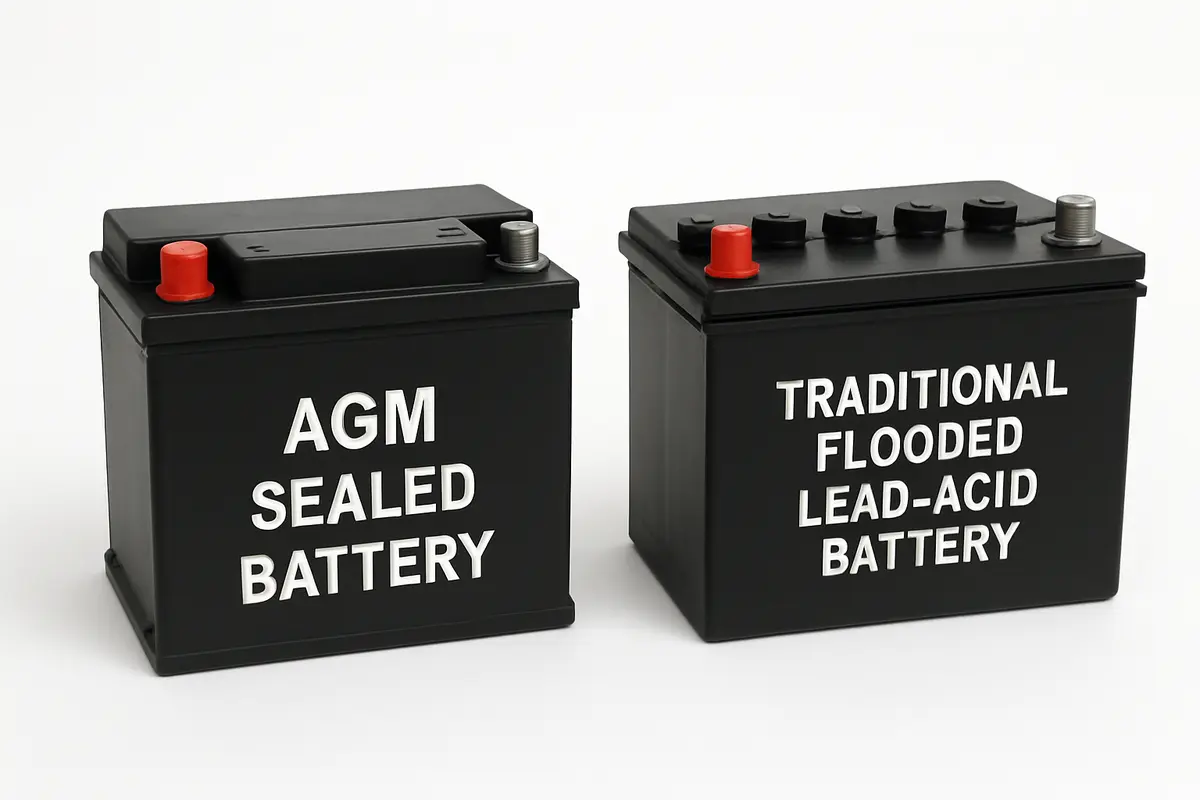
Quick Answer: AGM or Lithium-Ion for UPS?
For most UPS applications in 2026, AGM VRLA batteries remain the better value. AGM costs 40-60% less upfront, has zero thermal runaway risk, requires no battery management system (BMS), and delivers 10-15 year float life in standby service. Lithium-ion (specifically LiFePO4) wins on energy density, cycle life, and footprint — making it ideal for space-constrained data centers with frequent cycling. But lithium is not always the upgrade it appears to be. Here is the full engineering comparison from a manufacturer that makes AGM batteries and has watched the lithium transition closely.
Why This Comparison Matters Now
The battery market is at an inflection point. In 2020, roughly 90% of new data center UPS installations used VRLA AGM. By 2026, that share has dropped to approximately 55%, with lithium-ion taking the rest. But this headline number hides important context — most of the lithium adoption is happening in hyperscale facilities (Google, Amazon, Microsoft), where the footprint savings justify the higher cost. For small-to-mid-size UPS systems, the economics still favor AGM.
As a VRLA manufacturer, we are going to be straightforward: lithium-ion is the superior technology in some applications. But AGM still wins in many others. The right choice depends on your specific situation.
Head-to-Head Comparison: AGM vs Lithium-Ion for UPS
Where AGM Wins: 5 Applications That Still Favor Lead-Acid
1. Small to Mid-Size UPS Systems (under 100 kVA)
For a 10-30 kVA UPS protecting a server room or branch office, the battery cost is typically $2,000-$8,000 with AGM versus $6,000-$20,000 with lithium. The UPS itself may only cost $3,000-$15,000 — spending more on batteries than the UPS makes no financial sense when the battery will sit on float for 95%+ of its life.
Real math: A 20 kVA UPS with 15 minutes runtime needs approximately 10 kWh of battery capacity. At $200/kWh for AGM versus $500/kWh for lithium, that is $2,000 versus $5,000. Over a 10-year period with one AGM replacement at year 7, total battery cost is $4,000 for AGM versus $5,000 for lithium (no replacement needed). The savings are marginal, and AGM has lower risk.
2. Temperature-Extreme Locations
AGM batteries tolerate a wider real-world temperature range without expensive thermal management. Outdoor telecom cabinets, factory floors, and warehouse UPS systems often operate at 30-40 degrees C ambient. AGM performance degrades gradually with heat but does not shut down — lithium BMS systems may disconnect the battery entirely at high temperatures to protect cells from thermal damage.
3. Facilities Without Enhanced Fire Suppression
NFPA 855 (Standard for the Installation of Stationary Energy Storage Systems) requires risk assessments and potentially enhanced fire suppression for lithium-ion installations above certain thresholds. Many existing buildings — especially older offices, retail stores, and small data rooms — lack the infrastructure for these upgrades. AGM batteries have no thermal runaway mode and fit within standard fire code provisions.
4. Budget-Constrained Projects
When capital expenditure (CapEx) is the primary constraint, AGM delivers reliable backup power at the lowest upfront cost. This is common in developing markets, government projects with fixed budgets, and small businesses. A quality AGM battery from a reputable manufacturer will provide 8-12 years of reliable standby service.
5. Applications Requiring Proven 20+ Year Track Records
Critical infrastructure — hospitals, nuclear facilities, military installations, financial trading floors — often requires battery technologies with decades of field data. AGM VRLA has a 40+ year track record in these environments. Lithium-ion for stationary UPS has roughly 8-10 years of large-scale deployment data.
Need help choosing? Our engineering team provides free battery technology consultations for UPS and telecom applications. Contact us with your specifications.
Where Lithium-Ion Wins: When the Premium Is Justified
1. Space-Constrained Data Centers
If rack space costs $1,000-$3,000 per month per cabinet, the 40-60% footprint reduction from lithium-ion pays for itself within 2-3 years. Hyperscale and colocation facilities with high $/sqft costs see clear ROI from lithium.
2. Frequent Cycling Applications
UPS systems that experience frequent power outages (more than 50 discharge events per year) will burn through AGM batteries in 3-5 years. Lithium delivers 3,000-5,000 cycles versus 200-500 for AGM at equivalent DOD. In regions with unreliable grid power, lithium total cost of ownership is significantly lower.
3. New-Build Facilities Designed for Lithium
New data centers and telecom hubs increasingly specify lithium from day one, with appropriate BMS integration, fire suppression, and monitoring systems designed into the building. In this scenario, the incremental cost of lithium over AGM is offset by the longer replacement cycle and reduced maintenance.
The Hidden Costs Nobody Mentions
Lithium Hidden Costs
- **BMS replacement/repair:** Battery management systems can fail independently of the cells, costing $500-$2,000 per module - **Fire suppression upgrades:** $5,000-$50,000 depending on facility size and local codes - **Insurance premiums:** Some insurers charge 10-25% more for facilities with large lithium installations - **End-of-life disposal:** Lithium recycling infrastructure is still developing; disposal costs are $0.50-$1.50/kg versus near-zero for lead-acid (which has scrap value) - **Communication protocol integration:** Lithium BMS requires Modbus/CANbus integration with UPS — compatibility issues are commonAGM Hidden Costs
- **Replacement labor:** Battery swaps every 7-10 years require electrician time ($500-$2,000 per swap) - **Weight/structural:** AGM is 2-3x heavier — floor loading may need reinforcement for large installations - **Cooling costs:** AGM generates more heat during float charging (lower charge efficiency), increasing HVAC load by 5-10% - **Recycling logistics:** While lead-acid recycling is mature, transport of spent batteries involves hazardous materials regulationsTemperature: The Great Equalizer
Both technologies degrade in heat, but in different ways:
AGM at elevated temperatures: - 25 degrees C: 100% of rated life (baseline) - 30 degrees C: approximately 70% of rated life - 35 degrees C: approximately 50% of rated life - 40 degrees C: approximately 35% of rated life - Degradation is gradual, predictable, and follows the Arrhenius equation
Lithium-ion at elevated temperatures: - 25 degrees C: 100% of rated life (baseline) - 35 degrees C: approximately 80% of rated life - 45 degrees C: BMS may throttle or disconnect (application-dependent) - Degradation pattern is non-linear and can include sudden capacity cliffs
The key insight: **AGM degrades gracefully. Lithium can fail abruptly** when BMS protection limits are reached. For applications without reliable HVAC, AGM is the safer choice.
Total Cost of Ownership: Real Numbers
Here is a 15-year TCO comparison for a typical 40 kVA UPS installation requiring 20 kWh of battery capacity:
For standby-only applications with fewer than 20 discharge events per year, AGM delivers lower 15-year TCO. The calculation shifts toward lithium when cycling frequency exceeds 50-100 events per year.
Our Recommendation: Decision Framework
Choose AGM when: - Budget is the primary constraint - UPS is in standby mode 95%+ of the time - Facility lacks enhanced fire suppression - Operating temperature exceeds 35 degrees C regularly - System size is under 100 kVA - Your organization prefers proven technology with 40+ year track records
Choose lithium-ion when: - Space is at a premium ($1,000+/sqft annually) - Frequent power outages cause more than 50 discharge cycles per year - New facility with lithium-compatible fire systems - 15+ year deployment with zero-touch battery maintenance required - Weight is a structural concern (rooftop or upper-floor installations)
Related Resources
- AGM vs Gel Battery: Which Is Better for UPS? — Compare the two VRLA technologies - How to Choose UPS Battery — Step-by-step UPS battery selection - UPS Battery Sizing for Data Centers — Calculate your exact capacity needs - AGM Battery Cycle Life: Real Factory Data — What cycle life numbers actually mean - VRLA Battery Maintenance Guide — Maximize AGM lifespan - 12V AGM Battery Products — Naradex ND12 series specifications - 2V Stationary Battery Products — NL2 series for large UPS strings
Get a Custom Battery Recommendation
Choosing between AGM and lithium for your UPS does not have to be complicated. Send us your load specifications, runtime requirements, and facility constraints — our engineering team will provide a detailed technology comparison and quotation within 24 hours.