
AGM SLA Battery Buyer's Guide: Select by Application — UPS, Telecom & Solar
AGM SLA battery selection guide: how to choose the right sealed lead acid battery for UPS, telecom, solar, emergency lighting. Specifications, charging, troubleshooting, and China sourcing. Factory direct pricing →
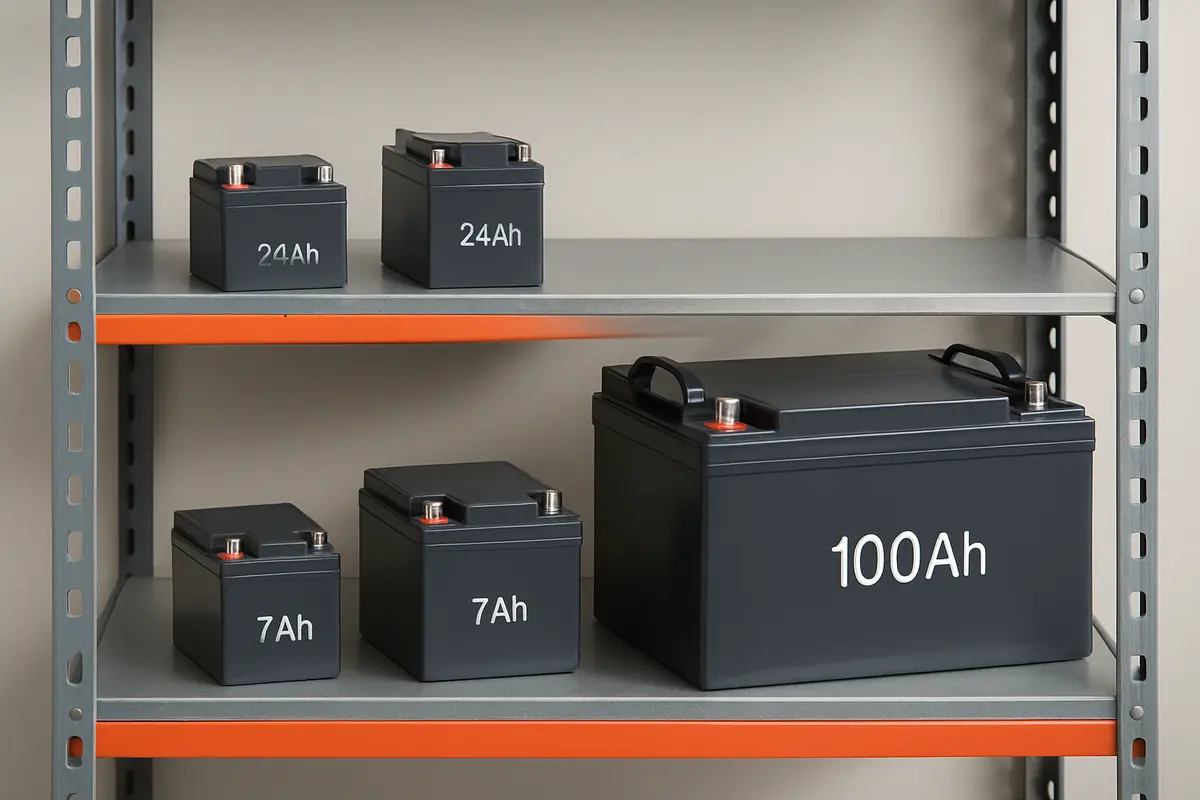
What Is an SLA Battery? (Quick Answer)
An **SLA battery** (Sealed Lead Acid battery) is a rechargeable battery that stores energy using lead plates and sulfuric acid electrolyte inside a sealed, maintenance-free enclosure. The electrolyte is immobilized — either absorbed in a glass mat (AGM) or gelled with silica (Gel) — so the battery never needs water refilling and can operate in any orientation without spilling.
SLA batteries are also called **VRLA batteries** (Valve Regulated Lead Acid). They are the most widely deployed rechargeable battery technology for backup power, telecom infrastructure, emergency systems, and solar energy storage worldwide — with over 400 GWh shipped annually. If you are sourcing batteries for any stationary power application, this guide will help you select the right SLA battery for your specific needs.
SLA Battery Types: Which One Do You Need?
Not all SLA batteries are the same. The two main types — AGM and Gel — serve different applications, and choosing the wrong one costs you money in premature replacements or oversized systems. For an in-depth comparison of all three sealed battery types, see our SLA vs AGM vs gel cell batteries guide. If you're specifically comparing AGM against traditional flooded types, read AGM battery vs lead acid.
Flooded vs AGM vs Gel: Side-by-Side Comparison
Bottom line for buyers: If your application requires maintenance-free, sealed operation — which covers 90% of commercial and industrial use cases — your real choice is between AGM and Gel. Flooded batteries only make sense for utility substations where trained maintenance crews perform regular water checks.
AGM SLA Batteries
AGM technology uses a fiberglass mat separator compressed between lead plates. The mat absorbs and holds the sulfuric acid electrolyte through capillary action, leaving no free-flowing liquid.
Why buyers choose AGM: - 15-25% lower internal resistance than Gel → delivers more power per kilogram during short, high-current discharges - Faster recharge (accepts up to 0.25C charge current) → battery ready for the next outage sooner - 20-30% lower cost than Gel at equivalent capacity → better ROI for standby applications
The Naradex ND12 Series uses advanced PAM (Positive Active Material) additives that extend cycle life to **800 cycles at 50% DOD** — significantly above the industry average of 500-600 cycles for standard AGM.
Gel SLA Batteries
Gel technology mixes the sulfuric acid with fumed silica (SiO₂) to create a thick gel electrolyte that fills the entire cell cavity, completely eliminating acid stratification.
Why buyers choose Gel: - Superior deep cycle performance → 1,500+ cycles at 80% DOD - Better thermal tolerance → gel dissipates heat more effectively, maintaining performance at temperatures up to 40°C where AGM life degrades rapidly - Longer calendar life → 20+ year design life for OPzV tubular gel types
The Naradex OPzV2 Series combines gel electrolyte with tubular positive plates, achieving 20+ year design floating life and 1,500+ cycles at 80% DOD — the gold standard for solar and utility-scale energy storage.
How to Choose the Right SLA Battery for Your Application
Selecting the wrong battery type wastes budget and shortens system life. Use the decision matrix below to match your application to the optimal SLA technology.
Application Selection Matrix
Decision Flowchart
Step 1: Is it standby/backup or daily cycling? - Standby (UPS, telecom, emergency) → AGM is almost always the best value - Daily cycling (solar, EV) → Gel is worth the premium
Step 2: What is the ambient temperature? - Below 35°C with climate control → AGM performs excellently - Above 35°C or no HVAC → Gel lasts 2-3× longer in heat (see temperature derating table in our AGM vs Gel comparison)
Step 3: What is the total cost sensitivity? - Budget-driven → AGM (20-30% lower upfront cost) - TCO-driven (10+ year horizon) → Gel (longer life = fewer replacements = lower TCO)
SLA Battery Specifications You Need to Know
When evaluating SLA batteries from any manufacturer, these are the critical specifications to verify before purchasing.
Voltage
SLA batteries come in **2V, 6V, and 12V** configurations. System voltage determines how many batteries you connect in series: - 12V system: 1× 12V battery (or 6× 2V cells) - 24V system: 2× 12V batteries in series - 48V system: 4× 12V batteries in series (or 24× 2V cells) - 110V/120V DC: Common in utility substations, using 55-60× 2V cells
Capacity (Ah)
Capacity is rated in **Amp-hours (Ah)** at a specific discharge rate. Pay attention to the C-rate: - **C10 (10-hour rate):** Industry standard for stationary batteries. A 100Ah (C10) battery delivers 10A for 10 hours. - **C20 (20-hour rate):** Common in North American markets. The same battery might be rated 105Ah at C20. - **C3 or C1 (high-rate):** Used for UPS sizing. Capacity is significantly lower — a 100Ah (C10) battery might only deliver 70Ah at C3.
Buyer tip: Always compare capacity at the same C-rate. A battery rated "100Ah at C20" is NOT equivalent to one rated "100Ah at C10" — the C10-rated battery actually stores more usable energy.
Depth of Discharge (DOD)
DOD dramatically affects cycle life. Using the Naradex ND12-100 as an example:
Buyer takeaway: Shallower discharge = dramatically longer life. For maximum ROI, design your system to operate at 50% DOD or less. The Naradex ND12-100 delivers **40,000 Ah of total lifetime energy** at 50% DOD — nearly 3× the total energy of full-depth cycling.
Float Life vs Cycle Life
These are two different lifespan measures that matter for different applications: - **Float life (design life):** How long the battery lasts in standby at 25°C with correct float voltage. The ND12 series is rated for **10-12 years float life**. This is what matters for UPS and telecom. - **Cycle life:** How many charge-discharge cycles the battery survives at a given DOD. This is what matters for solar and cycling applications.
Temperature derating rule: Every 8-10°C above 25°C halves float life. A 10-year battery at 35°C becomes a 5-year battery. This is a fundamental electrochemical constraint, not a quality issue — it applies to all lead-acid batteries regardless of manufacturer.
SLA Battery Charging Best Practices
Incorrect charging is the #1 cause of premature SLA battery failure. Follow these guidelines to maximize your battery investment.
Float Charging vs Cyclic Charging
Critical Charging Rules
1. Never exceed maximum charge voltage. Overcharging is the fastest way to destroy an SLA battery. For Gel batteries, exceeding 14.2V (12V battery) causes irreversible gel cracking that permanently reduces capacity.
2. Use temperature compensation. Adjust float voltage by **-3mV/°C/cell** (or -18mV/°C for a 12V battery) from the 25°C baseline. At 35°C, a 12V AGM battery should float at 13.50-13.62V instead of the standard 13.68-13.80V.
3. Match charger to battery type. AGM and Gel batteries require different charge profiles. A charger set to "flooded" mode will overcharge AGM/Gel batteries. Most quality chargers have a dedicated VRLA/AGM/Gel setting — use it.
4. Recharge promptly after discharge. Leaving an SLA battery in a discharged state causes sulfation — hard lead sulfate crystals form on the plates, permanently reducing capacity. Recharge within 24 hours of any discharge event.
5. Equalization charging for flooded — never for Gel. Equalization (controlled overcharge at 15.0-15.5V) is used for flooded batteries to remix stratified electrolyte. **Never equalize a Gel battery** — it will crack the gel. AGM batteries can tolerate brief equalization but it is rarely needed.
Common SLA Battery Problems and Solutions
Understanding failure modes helps you prevent them — and evaluate whether a battery truly needs replacement or just corrective action.
Sulfation (Most Common Problem)
Symptoms: Reduced capacity, longer charge time, battery does not reach full voltage Cause: Chronic undercharging, extended storage without maintenance charging, or deep discharge followed by delayed recharging Prevention: Maintain correct float voltage; recharge within 24 hours of any discharge; never store batteries below 12.0V (for 12V types) Recovery: Mild sulfation can sometimes be reversed with a controlled slow charge at 14.4V/0.05C for 24-48 hours. Hard sulfation (white crystal deposits visible on plates) is permanent.
Overcharging / Thermal Runaway
Symptoms: Battery hot to touch during float charge, swelling case, sulfur smell, increasing float current over time Cause: Float voltage too high, failed temperature compensation, defective charger Prevention: Verify float voltage quarterly; use chargers with temperature-compensated output; install ambient temperature sensors Action: If a battery is hot and swelling, **disconnect it immediately** — thermal runaway can escalate to venting and, in rare cases, fire. Replace the battery and investigate the charger.
Capacity Loss / Premature End-of-Life
Symptoms: UPS runtime significantly shorter than original; impedance testing shows >30% increase from baseline Cause: Normal aging (grid corrosion), excessive temperature exposure, or cycling at deep DOD Prevention: Install batteries in temperature-controlled rooms (20-25°C ideal); design systems for 50% DOD maximum; replace at 80% of design life. For a complete VRLA battery maintenance protocol that prevents premature capacity loss, see our 7-step guide. Evaluation: Perform a capacity test at C10 rate. If measured capacity is below 80% of rated capacity, the battery has reached end-of-life per IEEE 450 / IEC 60896 standards.
Uneven Cell Voltages in a String
Symptoms: One or more batteries in a series string read significantly higher or lower voltage than others (>0.3V difference in 12V units) Cause: Manufacturing variation, uneven temperature distribution, or one weak cell dragging down Prevention: Source all batteries from the same production lot; ensure uniform airflow across all batteries in the rack Action: Identify the weak battery by individual voltage measurement under load. Replace the entire string if batteries are past 50% of design life — mixing old and new batteries causes accelerated failure of the new ones.
How to Source SLA Batteries from a Chinese Manufacturer
China produces approximately 70% of the world's lead-acid batteries. For buyers importing SLA batteries, here is what you need to know to make the process smooth and ensure you receive quality product.
Key Specifications to Include in Your RFQ
Send potential manufacturers a clear specification sheet covering: - Battery type (AGM or Gel) and voltage/capacity - Required certifications (UL, CE, IEC 60896, TLC) - Terminal type and exact dimensions - Expected annual volume and delivery schedule - Whether you need OEM branding (custom labels, case color, carton printing)
Certifications That Matter
Shipping SLA Batteries Internationally
SLA (VRLA) batteries are classified as **Class 8 Corrosive, UN 2800** under international shipping regulations. However, because they are sealed and non-spillable, they qualify for exemptions that simplify logistics:
- **Sea freight:** Shipped as Class 8 with IMDG documentation. Full container load (FCL) is standard for volumes above 500 pcs. - **Air freight:** Permitted on cargo aircraft with proper DGR labeling. Not permitted on passenger aircraft. Cost is 3-5× sea freight. - **Palletization:** Batteries are heavy (30+ kg per 12V 100Ah unit). Proper palletization with banding and corner protection is critical to prevent damage.
MOQ guidance: Most Chinese manufacturers (including Naradex) have MOQ of **100-500 pieces** per model for standard products, or **500-1,000 pieces** for OEM-branded products. Smaller quantities are possible for first orders or trial shipments — contact us to discuss your specific requirements.
Factory Evaluation Checklist
Before committing to a large order, verify: - ✅ Factory has its own lead-acid production lines (not a trading company) - ✅ IEC 60896 or UL 1989 test reports from an accredited lab (not self-declared) - ✅ Environmental compliance (lead-acid manufacturing requires strict pollution controls) - ✅ Capacity to meet your volume with consistent quality (ask for monthly production capacity) - ✅ Willingness to provide samples for your own testing before bulk order
For a detailed walkthrough, see our complete guide to sourcing backup batteries from China.
Related Resources
- SLA vs AGM vs Gel Battery Comparison — Detailed technical comparison of SLA subtypes - AGM Battery vs Lead Acid — Key differences between AGM and flooded batteries - VRLA Battery Maintenance Guide — 7 steps to extend battery life - How to Charge AGM Batteries — Complete charging voltage and current guide - AGM vs Gel Battery for UPS — Head-to-head comparison for backup power - UPS Battery Sizing Guide — Calculate the right battery size for your system - Our AGM Battery Products — View the Naradex ND12 series specifications - AGM Battery Manufacturer — Learn about Naradex factory capabilities - UPS Battery Supplier — Bulk pricing and OEM services
Ready to Select Your SLA Battery?
Our engineering team helps buyers worldwide select and size SLA battery systems for UPS, telecom, solar, and industrial applications. Whether you need 100 pieces of 12V AGM or 10,000 pieces of 2V OPzV cells, we provide technical support from specification to delivery.