
SLA vs AGM vs Gel Battery: What Is the Difference? Complete Comparison
SLA vs AGM vs Gel battery — understand the difference between sealed lead acid battery types. Construction, performance, cost, lifespan, and best applications compared. Factory guide.
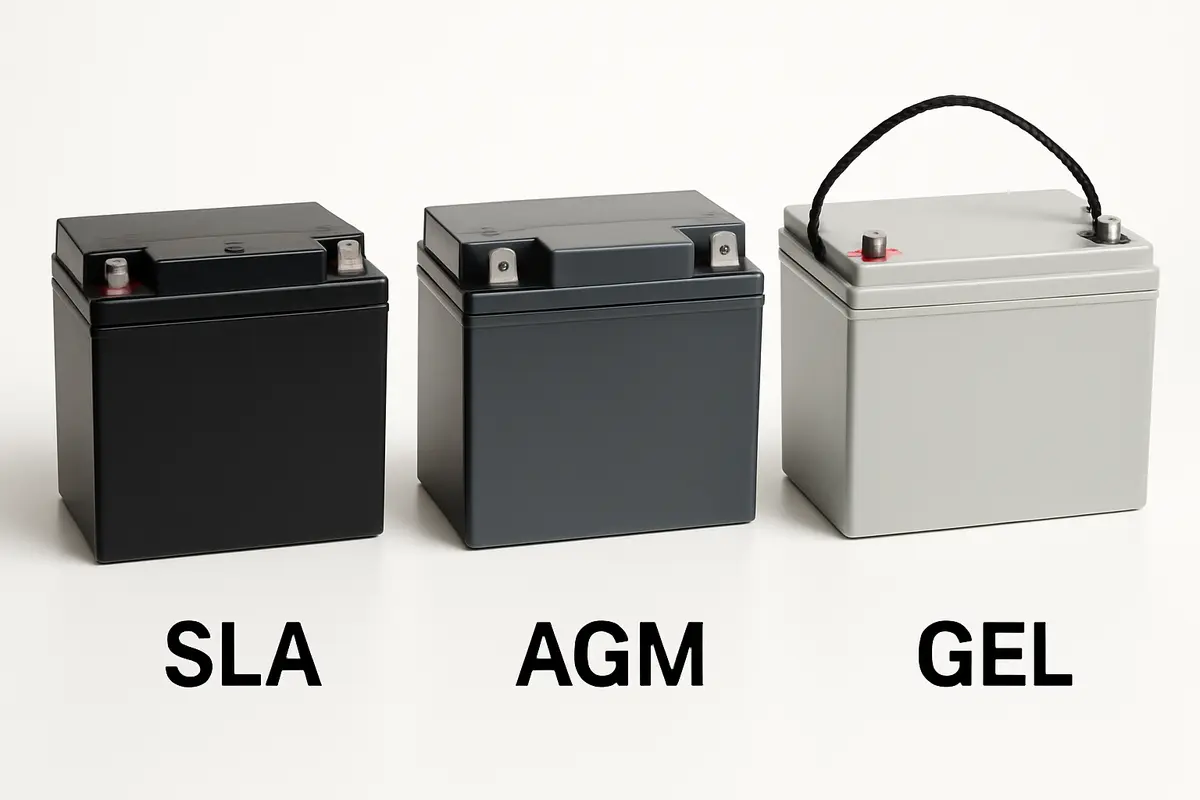
Quick Answer: SLA, AGM, and Gel Are All Sealed Lead-Acid Batteries
SLA (Sealed Lead Acid) is the umbrella term for any lead-acid battery that is sealed and maintenance-free. **AGM and Gel are the two types of SLA batteries** — they differ in how the electrolyte is immobilized.
- **SLA** = Sealed Lead Acid = the category (also called VRLA, Valve Regulated Lead Acid) - **AGM** = Absorbed Glass Mat = electrolyte absorbed in fiberglass mats - **Gel** = Gelled Electrolyte = electrolyte mixed with fumed silica to form a gel
If someone asks you to buy an "SLA battery," they typically mean an AGM battery — AGM accounts for over 80% of all SLA batteries sold worldwide.
What Is an SLA Battery?
SLA (Sealed Lead Acid) battery is a general term for any lead-acid battery that is sealed with a pressure-relief valve. Unlike traditional flooded (wet-cell) batteries, SLA batteries:
- Do not require water addition (maintenance-free) - Can be operated in any orientation (no liquid to spill) - Emit minimal gas under normal conditions (sealed with one-way valve) - Are classified as "non-spillable" for shipping (IATA/DOT exempt from hazmat in most cases)
The term **VRLA (Valve Regulated Lead Acid)** is technically more accurate — the battery is not truly "sealed" but has a pressure-relief valve that opens at 10-40 kPa to prevent explosion in case of overcharging.
AGM vs Gel: The Two Types of SLA/VRLA Batteries
AGM (Absorbed Glass Mat) Batteries
AGM batteries immobilize the electrolyte using a **fiberglass mat separator** between the plates. The mat absorbs approximately 95% of the sulfuric acid through capillary action.
Advantages of AGM: - Lower internal resistance → better high-rate discharge (ideal for UPS) - Faster recharging → accepts charge current up to 0.25C - Lower cost than gel batteries (20-30% less at equivalent capacity) - Better performance in standby/float applications
Limitations of AGM: - Less tolerant of deep cycling than gel - More sensitive to overcharging - Shorter cycle life at high depths of discharge
Gel Batteries
Gel batteries mix the sulfuric acid electrolyte with **fumed silica (SiO₂)** to create a thick, paste-like gel that fills the entire cell.
Advantages of Gel: - Superior deep cycle performance → 1,500+ cycles at 80% DOD - Better heat dissipation (gel conducts heat better than air gaps in AGM) - No acid stratification → uniform plate usage - Longer cycle life in solar/renewable energy applications
Limitations of Gel: - Higher internal resistance → less suitable for high-rate UPS discharge - Slower charging → maximum 0.15C charge current - Higher cost → 30-50% more than AGM at equivalent capacity - Sensitive to charging voltage (must not exceed 14.1V for 12V batteries)
SLA vs AGM vs Gel: Comparison Table
How to Choose: Application Guide
Choose AGM When:
- **UPS / backup power** — AGM's low internal resistance delivers more power during short, high-current discharge events - **Telecom base stations** — AGM's lower cost and reliable standby performance make it the industry standard - **Data centers** — AGM's fast recharge and high-rate capability match UPS requirements - **Emergency lighting** — AGM's long float life (5-12 years) and compact size fit building safety systems - **Fire alarm systems** — AGM meets UL and NFPA requirements for sealed, maintenance-free standby batteriesChoose Gel When:
- **Solar / renewable energy storage** — Gel's deep cycle capability (1,500+ cycles at 80% DOD) handles daily cycling - **Electric vehicles / golf carts** — Gel's tolerance for deep discharge extends service life - **Hot climates (>35°C ambient)** — Gel dissipates heat better than AGM - **Marine / offshore** — Gel's vibration resistance and deep cycle performance suit marine applications - **Cycling applications requiring maximum lifespan** — Gel costs more but delivers 2-3× the cycle life of AGM at deep DODThe Naradex Product Range
Related Resources
- [AGM vs Lead Acid Battery](/blog/agm-vs-lead-acid-battery-difference/) — AGM compared to traditional flooded batteries - [AGM vs Gel Battery for UPS](/blog/agm-vs-gel-battery-which-is-better-for-ups/) — Detailed UPS-focused comparison - [How to Charge AGM Batteries](/blog/how-to-charge-agm-battery-voltage-guide/) — Correct charging voltages and methods - [VRLA Battery Maintenance Guide](/blog/vrla-battery-maintenance-guide/) — Extend your battery's life