
What Is a Sealed Lead Acid Battery? Types, Applications & Buyer Guide
Sealed lead acid (SLA) battery explained: how it works, AGM vs Gel types, applications (UPS, telecom, solar, medical), sizing guide, lifespan data, and OEM sourcing tips from a manufacturer.
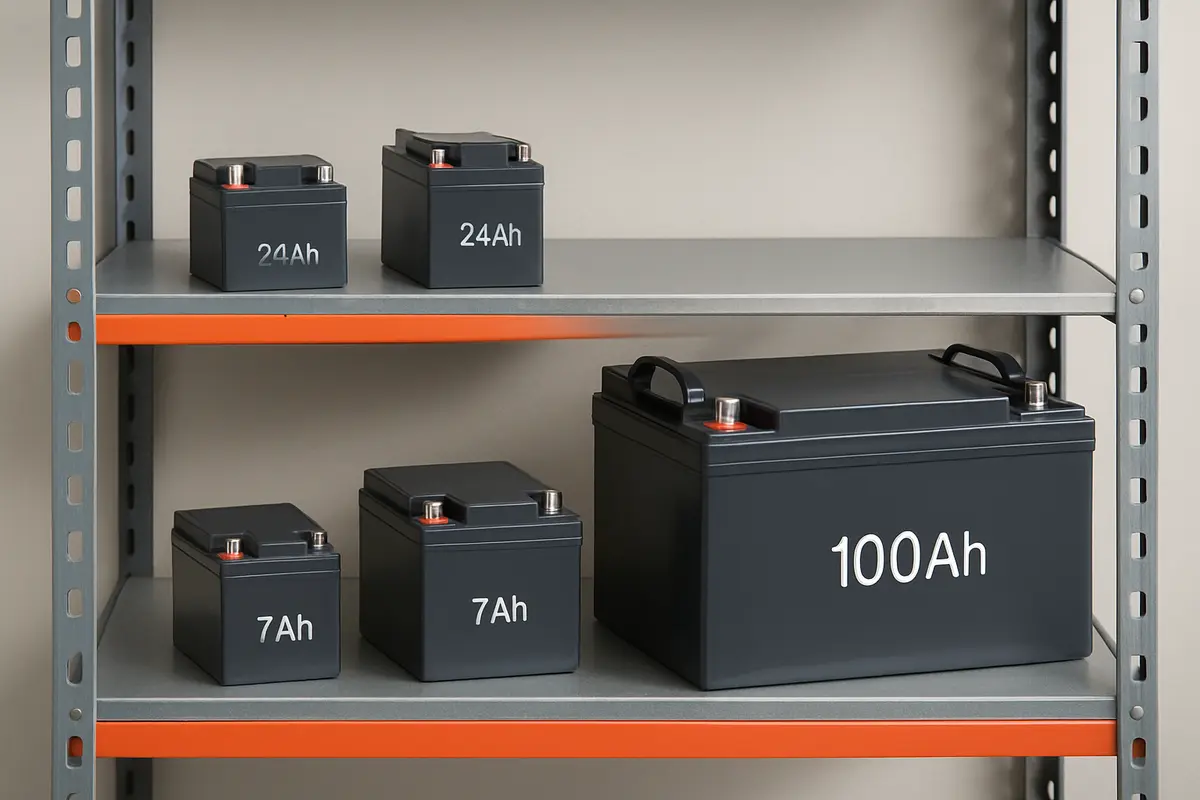
What Is a Sealed Lead Acid Battery?
A **sealed lead acid (SLA) battery** — also called a VRLA (Valve Regulated Lead Acid) battery — is a rechargeable battery that uses lead plates and sulfuric acid electrolyte in a sealed, maintenance-free enclosure. Unlike traditional flooded lead-acid batteries, the electrolyte in an SLA battery is immobilized (either absorbed in a glass mat or gelled with silica), so the battery can operate in any position without spilling acid.
The term "sealed" is slightly misleading — SLA batteries have a one-way **pressure-relief valve** (typically set at 10-40 kPa) that opens to release excess gas if the battery is overcharged. Under normal operating conditions, the internal oxygen recombination cycle keeps the battery truly sealed with no gas emission.
Key specifications of SLA batteries: - Nominal voltage: 2V, 6V, or 12V per unit - Capacity range: 0.5Ah to 3,000Ah+ - Design life: 3-20 years depending on design - Operating temperature: -20°C to +50°C - Self-discharge: 1-3% per month at 25°C
How Sealed Lead Acid Batteries Work
The electrochemistry is identical to all lead-acid batteries:
Discharge reaction: PbO₂ + Pb + 2H₂SO₄ → 2PbSO₄ + 2H₂O
During discharge, both the positive plate (lead dioxide, PbO₂) and negative plate (sponge lead, Pb) react with sulfuric acid to form lead sulfate (PbSO₄). The electrolyte becomes diluted (specific gravity drops from ~1.28 to ~1.10).
Charge reaction (reverse): 2PbSO₄ + 2H₂O → PbO₂ + Pb + 2H₂SO₄
During charging, the lead sulfate converts back to lead dioxide and sponge lead, and the sulfuric acid concentration is restored.
What makes SLA different: The oxygen recombination cycle. During charging, oxygen gas generated at the positive plate migrates through the separator to the negative plate, where it recombines with hydrogen to form water. This cycle operates at 95-99% efficiency, eliminating water loss and allowing the battery to remain sealed.
Types of Sealed Lead Acid Batteries
1. AGM (Absorbed Glass Mat) SLA Batteries
AGM batteries use a fiberglass mat separator that absorbs and holds the sulfuric acid electrolyte. The mat is compressed between the lead plates at a controlled pressure.
Best for: UPS backup, telecom, data centers, emergency lighting, fire alarms, security systems
Naradex AGM products: [ND12 Series (12V, 26-200Ah)](/products/12v-agm-battery/) and [NL2 Series (2V, 200-3000Ah)](/products/2v-stationary-battery/)
2. Gel SLA Batteries
Gel batteries mix the sulfuric acid with fumed silica (SiO₂) to create a gel-like electrolyte that fills the entire cell cavity.
Best for: Solar energy storage, deep cycling, marine, electric vehicles, harsh environments
Naradex Gel products: [OPzV2 Series (2V, 500-2000Ah)](/products/opzv-tubular-gel-battery/) — combining gel electrolyte with tubular positive plates for maximum cycle life
3. Classification by Application
Applications of Sealed Lead Acid Batteries
UPS (Uninterruptible Power Supply)
SLA batteries are the backbone of UPS systems protecting servers, networking equipment, medical devices, and industrial controls. When utility power fails, the UPS inverter draws on the SLA battery bank to maintain power for 5-30 minutes — enough time for generators to start or for graceful system shutdown.Typical UPS battery configuration: - Small office UPS: 1-2 × 12V 7-9Ah AGM batteries - Server room UPS: 8-40 × 12V 100-200Ah AGM batteries - Data center UPS: 40-240 × 2V 200-3000Ah AGM cells
Telecom Base Stations
Every cellular tower and telecom switching center requires battery backup to maintain service during power outages. The industry standard is a 48V battery string (four 12V batteries in series, or twenty-four 2V cells) providing 4-8 hours of backup.Emergency Lighting & Fire Alarm Systems
Building codes (NFPA 72, NFPA 101, IEC 60598) require battery-backed emergency lighting and fire alarm systems. SLA batteries are the default choice due to their sealed construction, long standby life, and predictable performance.Solar Energy Storage
Off-grid and hybrid solar systems use SLA batteries (particularly gel and deep-cycle AGM types) to store energy generated during daylight hours. While lithium-ion is gaining share, SLA batteries remain cost-effective for systems under 20 kWh where budget is a priority.Medical Equipment
Patient monitors, infusion pumps, powered wheelchairs, and portable diagnostic equipment rely on SLA batteries for reliable backup power. Medical-grade SLA batteries often carry additional certifications (IEC 60601, UL 1642).How to Choose the Right SLA Battery
Step 1: Determine Your Voltage Requirement
Match the battery voltage to your equipment's input voltage. Common configurations: - 12V systems: Single 12V battery - 24V systems: Two 12V batteries in series - 48V systems: Four 12V batteries in series, or twenty-four 2V cells - 110V/120V DC systems: Common in utility substationsStep 2: Calculate Required Capacity (Ah)
Formula: Capacity (Ah) = Load power (W) × Backup time (hours) ÷ Battery voltage (V) ÷ 0.8 (efficiency factor)Example: A 1,000W load requiring 30 minutes backup at 48V: Capacity = 1,000 × 0.5 ÷ 48 ÷ 0.8 = **13Ah minimum** (select 20Ah or higher for safety margin)
Step 3: Choose AGM or Gel
- **Standby backup (UPS, telecom):** AGM — lower cost, better high-rate performance - **Daily cycling (solar, EV):** Gel — superior cycle life at deep DOD - **Extreme temperatures:** Gel — better heat tolerance - **Budget-sensitive:** AGM — 20-30% lower costStep 4: Verify Physical Dimensions
SLA batteries come in standard sizes but vary by manufacturer. Measure your battery compartment and verify length × width × height before ordering. Terminal type (F1, F2, bolt, threaded insert) must also match.SLA Battery Lifespan and Maintenance
Although SLA batteries are "maintenance-free" (no water addition), they are not maintenance-zero. Best practices to maximize lifespan:
1. Maintain correct float voltage: 13.5-13.8V for 12V AGM, 13.5-13.8V for 12V Gel (verify with manufacturer datasheet)
2. Control temperature: Every 8-10°C above 25°C halves battery life. Install batteries in air-conditioned rooms when possible.
3. Test regularly: Perform impedance testing or load testing quarterly to identify weak cells before failure.
4. Replace on schedule: Even well-maintained SLA batteries degrade over time. Replace at 80% of design life (e.g., at 8 years for a 10-year design life battery).
5. Replace as a complete set: Never mix old and new batteries in a string — the oldest battery will limit performance and drag down the new ones.
Related Resources
- [AGM vs Lead Acid Battery](/blog/agm-vs-lead-acid-battery-difference/) — Compare sealed and flooded types - [SLA vs AGM vs Gel Battery](/blog/sla-vs-agm-vs-gel-battery-comparison/) — Understand the SLA subtypes - [How to Charge AGM Batteries](/blog/how-to-charge-agm-battery-voltage-guide/) — Correct voltage settings - [UPS Battery Buying Guide](/blog/how-to-choose-ups-battery-complete-guide/) — Choose the right backup battery