
Best Inverter Battery for Solar & Home Backup: AGM vs Gel vs Lithium (2026)
Best inverter battery for solar and home backup in 2026: deep-cycle AGM for budget systems, gel for hot climates, LiFePO4 for daily cycling. A manufacturer compares cost, lifespan, and sizing.
Quick Answer: What Is the Best Battery for an Inverter?
For most home inverter and solar backup systems in 2026, deep-cycle AGM batteries offer the best balance of cost, reliability, and lifespan. A quality 12V 100Ah deep-cycle AGM costs $200-350 and delivers 500-800 cycles at 50% depth of discharge — that is 3-5 years of daily solar cycling or 8-12 years of occasional backup use. Gel batteries cost 10-20% more but handle heat and deep discharges better. LiFePO4 lithium costs 2-3x more upfront but lasts 10+ years with 3,000+ cycles — the best long-term investment if budget allows.
What Makes a Good Inverter Battery? (It Is Not the Same as a Car Battery)
This is the most common mistake buyers make: using a regular car battery (SLI — Starting, Lighting, Ignition) with an inverter. Car batteries are designed to deliver high current for a few seconds during engine cranking, then immediately recharge from the alternator. They use thin plates optimized for surface area, not sustained discharge.
Inverter batteries need to deliver moderate current for hours — powering lights, fans, refrigerators, and electronics during a power outage or off-grid solar cycle. This requires **deep-cycle** construction with thick plates (2.5-4mm versus 1-1.5mm in car batteries) designed to withstand repeated deep discharges without rapid degradation.
Using a car battery with an inverter will kill it within 3-6 months. A proper deep-cycle battery will last 3-10+ years depending on the technology and usage pattern.
Inverter Battery Types Compared: AGM vs Gel vs Flooded vs Lithium
Deep-Cycle AGM: The Sweet Spot for Most Inverter Users
Why AGM Works Well for Inverters
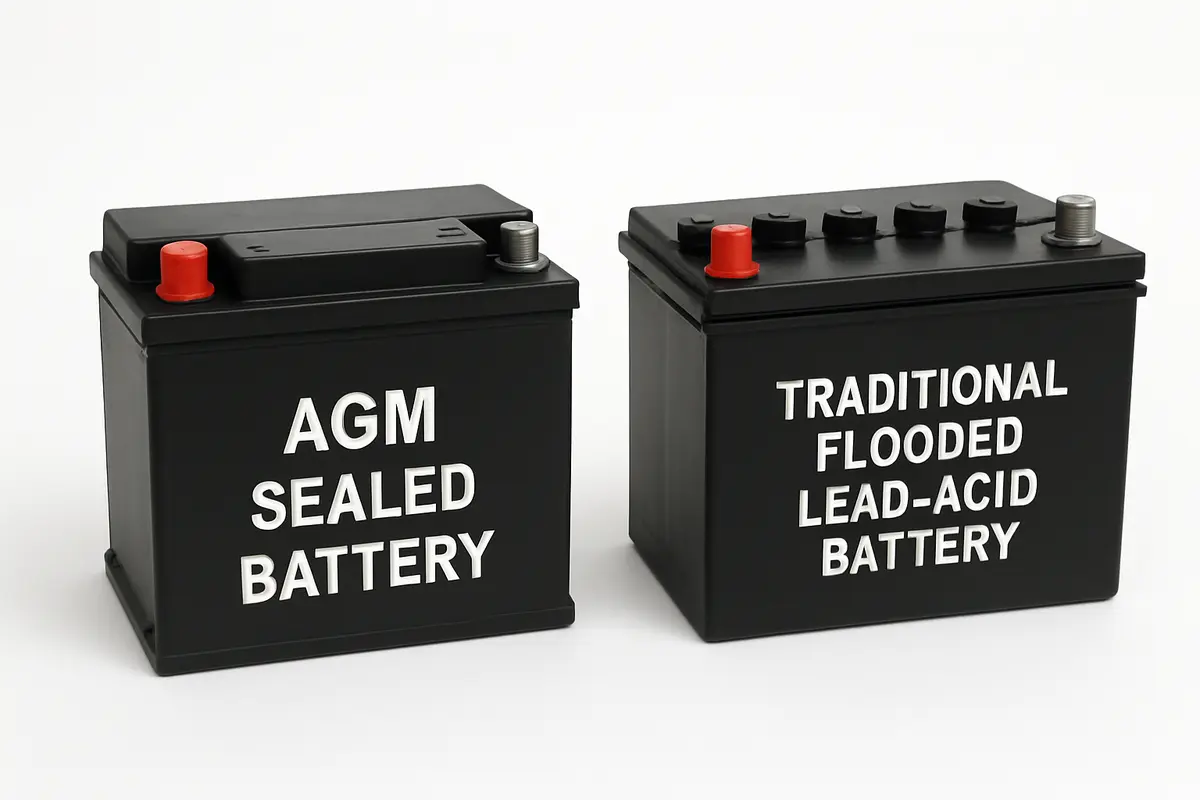
AGM (Absorbed Glass Mat) batteries absorb electrolyte into fiberglass mats between the plates, creating a sealed, maintenance-free battery that can be installed in any position. For inverter applications, deep-cycle AGM offers several advantages:
- **No maintenance:** No water additions, no acid checks, no terminal corrosion - **Low internal resistance:** Delivers stable voltage under inverter loads (important for sensitive electronics) - **Fast recharge:** Accepts charge 30-40% faster than gel, meaning shorter generator run times or more efficient solar harvesting - **Spill-proof:** Safe for indoor installation near living spaces
When to Choose AGM
- **Budget is a factor** but you want something better than flooded - **Backup power only** (fewer than 100 discharge cycles per year) — AGM shines in standby float service with 8-12 year life - **Moderate climate** — AGM performs best at 20-30 degrees C but handles up to 40 degrees C with reduced life - **Quick recharge needed** — faster charge acceptance means less generator fuel or more efficient solar charging
Recommended AGM Battery Specifications for Inverters
Our 12V Deep-Cycle AGM batteries are engineered specifically for inverter and solar applications, with thick-plate construction that delivers 800+ cycles at 50% DOD.
Gel Batteries: Best for Hot Climates and Daily Solar Cycling
Why Gel Excels in Heat
Gel batteries use silica-gelled electrolyte that resists acid stratification and handles elevated temperatures better than AGM. In regions where ambient temperatures regularly exceed 35 degrees C — the Middle East, South Asia, Africa, Southeast Asia — gel batteries outlast AGM by 30-50%.
Heat performance comparison at 35 degrees C average: - AGM: 50% of rated float life (approximately 4-6 years) - Gel: 65-70% of rated float life (approximately 6-10 years) - The difference comes from gel electrolyte lower evaporation rate and more uniform plate reaction
When to Choose Gel
- **Hot climate** where battery temperatures regularly exceed 35 degrees C - **Daily solar cycling** — gel delivers 700-1,200 cycles at 50% DOD versus 500-800 for AGM - **Deep discharge tolerance** — gel handles accidental deep discharges (below 20% SOC) better than AGM without permanent damage - **Telecom towers and remote solar** — gel 15+ year standby life reduces maintenance visits to remote sites
Gel Battery Sizing for Solar Inverter Systems
For off-grid solar, the battery bank must store enough energy for 2-3 days of autonomy (cloudy days). A typical formula:
Battery capacity (Ah) = Daily energy use (Wh) x Days of autonomy / Battery voltage / DOD
Example: 3,000 Wh daily use, 2 days autonomy, 48V system, 50% DOD: 3,000 x 2 / 48 / 0.50 = 250Ah at 48V (which means 4x 12V 250Ah batteries in series)
Our 12V Deep-Cycle Gel and 2V Deep-Cycle Gel batteries are specifically designed for solar inverter systems with 1,200+ cycle life at 50% DOD.
Looking for solar or inverter battery solutions? Contact our team for free sizing calculations based on your load profile.
LiFePO4 Lithium: The Premium Long-Term Choice
Why Lithium Is Gaining Ground
LiFePO4 (Lithium Iron Phosphate) batteries are transforming the inverter battery market for users willing to invest in long-term value:
- **3-5x more usable capacity** — you can safely use 80-90% of rated capacity versus 50% for lead-acid, meaning a 100Ah lithium battery delivers as much usable energy as a 200Ah AGM - **3,000-5,000 cycles** at 80% DOD — lasting 8-15 years of daily solar cycling - **70% lighter** — easier to install, less structural concern - **2-4 hour full charge** versus 6-12 hours for lead-acid — critical for solar systems with limited peak sun hours
When Lead-Acid Still Makes More Sense Than Lithium
- **Backup-only use** (fewer than 50 cycles per year) — lead-acid float life of 8-15 years makes the lithium premium unnecessary - **Budget under $500 for the battery bank** — a $200 AGM battery does the job for light backup use - **No BMS expertise** — lithium requires proper BMS configuration; mismatched charging can damage cells or create safety risks - **Extreme cold** — lithium BMS typically prevents charging below 0 degrees C, while lead-acid can charge (slowly) at -20 degrees C
How to Size Your Inverter Battery Bank: Step-by-Step
Step 1: Calculate Your Load
List every device you want to power during an outage and multiply watts by hours:
Step 2: Account for Inverter Efficiency
Inverters are 85-93% efficient. Divide total Wh by 0.85 (conservative):
5,710 / 0.85 = **6,718 Wh** actual battery energy needed per day
Step 3: Apply DOD Limit
For AGM/gel at 50% DOD: 6,718 / 0.50 = **13,435 Wh** total battery capacity For lithium at 80% DOD: 6,718 / 0.80 = **8,397 Wh** total battery capacity
Step 4: Choose Configuration
For a 48V system with AGM: 13,435 Wh / 48V = **280Ah** at 48V = 4x 12V 300Ah AGM batteries in series
For a 48V system with lithium: 8,397 Wh / 48V = **175Ah** at 48V = one 48V 200Ah LiFePO4 module
Step 5: Add Autonomy Days
Multiply by the number of days you want backup without solar/grid: - 1 day autonomy: multiply by 1 (minimum for grid-connected with solar) - 2 days: multiply by 2 (standard for off-grid solar) - 3 days: multiply by 3 (recommended for critical loads or unreliable weather)
5 Common Inverter Battery Mistakes (and How to Avoid Them)
Mistake 1: Using a car battery. Car batteries (SLI type) have thin plates designed for brief high-current cranking. Deep-discharging a car battery destroys it within weeks. Always use deep-cycle batteries rated for inverter use.
Mistake 2: Mixing old and new batteries. Never add a new battery to an existing bank. The old battery internal resistance is higher, causing the new battery to overwork and fail prematurely. Replace the entire bank at once.
Mistake 3: Undersizing the battery bank. Running batteries below 50% state of charge regularly cuts AGM/gel life by 50-70%. Size your bank so normal daily use stays above 50% SOC (above 20% SOC for lithium).
Mistake 4: Poor ventilation. Even sealed VRLA batteries release small amounts of hydrogen during equalization charging. Install batteries in a ventilated space — not sealed closets. Lithium batteries also generate heat during fast charging and need airflow.
Mistake 5: Wrong charge voltage. AGM typically charges at 14.4-14.7V (per 12V battery), gel at 14.0-14.4V, and LiFePO4 at 14.2-14.6V. Using AGM charge settings on gel batteries causes overcharging and premature failure. Verify your inverter charger settings match your battery type.
Related Resources
- AGM vs Gel Battery: Which Is Better for UPS? — Detailed comparison of VRLA technologies - How to Charge AGM Battery: Voltage Guide — Correct charging voltages and methods - AGM Battery Lifespan: How Long Do They Last? — Real-world lifespan data - Battery Backup Time Calculator — Calculate your exact runtime - SLA vs AGM vs Gel Battery Comparison — All sealed battery types compared - 12V Deep-Cycle AGM Products — Batteries designed for inverter and solar - 12V Deep-Cycle Gel Products — Heat-resistant deep-cycle gel batteries - OPzV Tubular Gel Products — Premium long-life solar batteries
Get Free Inverter Battery Sizing Help
Not sure which battery type or capacity is right for your inverter system? Send us your load list, inverter model, and climate zone — our engineers will calculate the optimal battery configuration and provide a quotation within 24 hours.