
AGM vs Flooded Battery: Engineering Comparison for Industrial Applications
AGM vs flooded battery — in-depth engineering comparison covering electrolyte design, high-rate discharge, cycle life, TCO analysis, and migration guide. Factory test data included. Get quote →
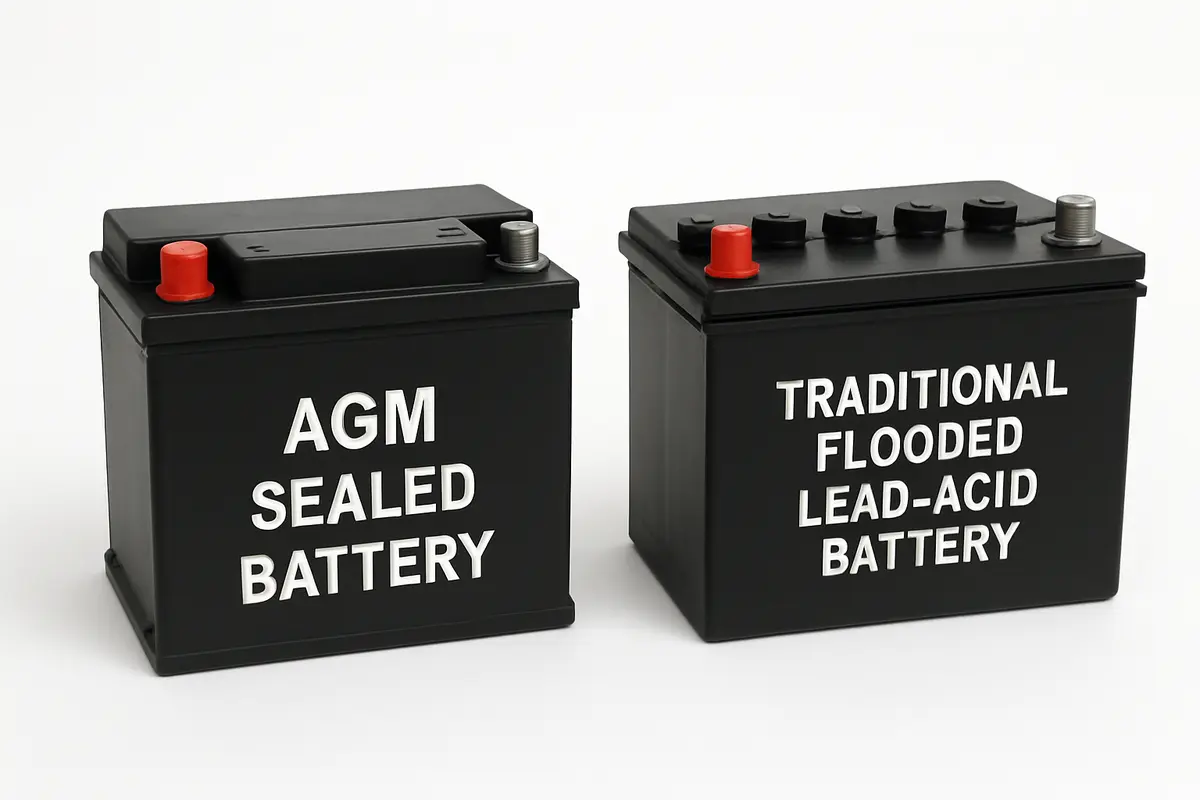
Quick Answer: AGM vs Flooded Battery
AGM (Absorbed Glass Mat) and flooded (wet-cell) batteries share the same lead-acid electrochemistry but differ fundamentally in electrolyte management. Flooded batteries use free-flowing liquid sulfuric acid that requires venting and periodic water addition. AGM batteries immobilize the electrolyte in a fiberglass mat separator, enabling a sealed, valve-regulated (VRLA) design that eliminates maintenance. For industrial applications — UPS, telecom, data centers — AGM delivers lower internal resistance, faster recharge, and zero maintenance at a higher upfront cost. Flooded batteries remain cost-effective for large utility substations and deep-cycle applications where dedicated maintenance crews are available.
How the Two Technologies Work: A Structural Comparison
Flooded (Wet-Cell) Lead-Acid Battery
In a flooded battery, lead plates are submerged in a **free-flowing sulfuric acid electrolyte** (specific gravity 1.215-1.280 at 25 degrees C). During charge and discharge, the electrolyte actively participates in the reaction — sulfate ions migrate between the plates and the liquid.
Key structural characteristics: - **Electrolyte volume:** Excess liquid (10-15% above plate tops) acts as a thermal buffer and acid reservoir - **Venting:** Open or flame-arrestor caps allow hydrogen and oxygen gases to escape during charging - **Acid stratification:** In tall cells, acid concentration gradients develop — heavier acid (higher SG) sinks to the bottom, causing uneven plate wear and capacity loss - **Plate alloy:** Antimony-lead (Pb-Sb, 1.5-6% Sb) for deep-cycle, or calcium-lead (Pb-Ca) for maintenance-free starting batteries
Flooded batteries require **equalization charging** — a controlled overcharge at 2.50-2.67 V/cell — to remix stratified electrolyte and prevent capacity degradation. This process generates significant hydrogen gas, requiring ATEX-compliant ventilation per IEC 62485-2.
AGM (Absorbed Glass Mat) Battery
AGM batteries use a **borosilicate glass microfiber mat** (typically 1.0-1.3 mm thick) sandwiched between the positive and negative plates. This mat absorbs approximately 95% of the electrolyte through capillary action, leaving 5% void space for the oxygen recombination cycle.
Key structural characteristics: - **Electrolyte state:** Immobilized within the glass mat — no free liquid, no sloshing, no stratification - **Recombination:** Oxygen generated at the positive plate during charging migrates through the mat unfilled pores to the negative plate, where it recombines with hydrogen to form water — achieving more than 99% gas recombination efficiency - **Sealing:** Pressure-relief valve (VRLA) opens at 10-40 kPa to prevent case rupture, but under normal operation the cell remains sealed - **Plate alloy:** Calcium-lead (Pb-Ca-Sn, 0.06-0.08% Ca, 0.5-1.5% Sn) for low water loss and long float life - **Compression:** Plates and mats are assembled under controlled compression to ensure uniform electrolyte distribution and low internal resistance
The absence of free liquid means AGM batteries can be installed in any orientation, require no water addition, and emit negligible hydrogen gas under normal float conditions.
Head-to-Head Engineering Comparison
This table covers the parameters that matter most when specifying batteries for industrial power systems.
*Source: Naradex ND12 and NL2 series factory test data per IEC 60896-21/22; flooded data from industry composite benchmarks.*
Performance Under Real Operating Conditions
Laboratory specifications tell only part of the story. Here is how AGM and flooded batteries perform under the conditions that actually matter in the field.
High-Rate Discharge: AGM Wins Decisively
UPS and telecom applications demand high-current discharge for short durations — typically 5-30 minutes. AGM batteries dominate here because of their lower internal resistance.
*Source: Naradex ND12-100 factory discharge testing at 25C, 1.75V/cell end voltage. Flooded values from equivalent-size flat-plate flooded battery.*
The practical impact: for a given UPS load, you need **25-30% fewer AGM batteries** than flooded batteries to achieve the same runtime. This reduces rack space, floor loading, and cable costs.
Deep Cycling: Design Matters More Than Chemistry
For applications involving regular deep discharge — solar storage, load-leveling, floor scrubbers — the comparison depends on the specific battery design rather than AGM vs. flooded as a category.
The takeaway: do not assume "flooded = better for cycling." Standard flat-plate flooded batteries deliver only 300-500 cycles at 50% DOD — worse than enhanced AGM. The superior cyclers are **tubular plate designs** (OPzS flooded and OPzV gel), where the tubular positive plate structure resists active material shedding during deep discharge.
Temperature Extremes: Each Technology Has Its Range
High temperature (above 30C): Flooded batteries tolerate sustained heat better than AGM. The excess free electrolyte acts as a thermal buffer, and water can be replenished as it evaporates. AGM batteries lose electrolyte permanently through valve venting when overheated — there is no way to refill a sealed cell.
*Source: Naradex accelerated life testing per IEC 60896-21/22. Both types follow the Arrhenius equation — every 8-10C above 25C approximately halves float life.*
Low temperature (below 0C): AGM batteries retain more capacity at cold temperatures. The immobilized electrolyte does not suffer the increased viscosity and reduced ionic mobility that impair flooded battery performance in cold environments.
At -20C, an AGM battery retains approximately **50% of rated capacity**, while a flooded battery may drop to **30-40%**. For outdoor telecom cabinets, arctic mining operations, and cold-storage facilities, AGM is the more reliable choice.
Application Recommendations: When to Use Which
Choose Flooded Batteries When:
1. Large utility substations with dedicated battery rooms. At the 1,000+ kWh scale, the cost savings of flooded batteries ($0.80-$1.50/Ah vs. $1.50-$3.50/Ah for AGM) become substantial. Utility substations typically have trained maintenance crews who perform quarterly water checks and annual equalization charges. Tubular plate OPzS flooded batteries in this setting deliver 15-20 year service life.
2. High-ambient-temperature environments (above 35C) without reliable cooling. In regions with sustained high temperatures and no air-conditioned battery rooms — common in Middle East substations, African telecom towers, and tropical industrial facilities — flooded batteries tolerate the heat better because electrolyte loss can be replenished.
3. Deep-cycle applications prioritizing lowest cost per cycle. For industrial floor scrubbers, electric forklifts, and golf carts where batteries cycle daily and trained operators are available to check water levels, flooded deep-cycle batteries offer the lowest operating cost.
Choose AGM Batteries When:
1. UPS and data center backup. AGM is the industry standard for UPS applications. Its lower internal resistance delivers more watts per kilogram during the 5-30 minute high-rate discharges typical of utility power outages. The Naradex ND12 series delivers 360W per cell at the 15-minute rate — 35-40% higher than equivalent flooded batteries.
2. Telecom base stations and remote sites. No maintenance access + enclosed cabinet installation = AGM is the only practical option. The sealed construction eliminates acid spill risk during transport to remote tower sites, and the non-spillable UN 2800 classification simplifies international shipping logistics.
3. Enclosed or occupied spaces. Office UPS rooms, hospital backup systems, retail standby power — any location where hydrogen gas accumulation poses a safety risk or ventilation infrastructure is cost-prohibitive. AGM batteries emit less than 0.01% of the hydrogen gas produced by flooded batteries under normal float conditions.
4. Applications requiring fast recharge. AGM batteries accept charge current at 0.25C-0.30C versus 0.10C-0.20C for flooded batteries. For applications with short recharge windows between outages (e.g., regions with frequent load shedding), AGM recovers to full charge 40-50% faster.
Total Cost of Ownership: 10-Year Analysis
The upfront price difference between AGM and flooded batteries tells only half the story. A full TCO analysis must include maintenance labor, infrastructure costs, replacement frequency, and downtime risk.
Scenario: 48V / 100Ah UPS System (4 x 12V 100Ah batteries per string)
*Assumptions: Flooded battery replaced every 4-5 years; AGM replaced once at year 8-10; maintenance labor at $30-$50/hour; ventilation costs amortized over 10 years.*
Key TCO Insight
Even though AGM batteries cost 2-3x more upfront, **the total 10-year cost is typically 50-80% lower** when you factor in infrastructure, maintenance, and replacement frequency. This is why over 90% of new UPS installations worldwide specify AGM or gel VRLA batteries — the total cost equation is not even close.
The exception: very large flooded OPzS installations (1,000+ kWh) at utility substations, where the 15-20 year life of tubular flooded cells and the availability of on-site maintenance crews can make flooded batteries competitive on TCO.
Migration Guide: Switching from Flooded to AGM
Many facilities are replacing aging flooded battery systems with AGM. Here is what the engineering team needs to address during the transition.
1. Charger and UPS Settings — Critical Adjustments
The most critical change: Disable any equalization charge function. Equalization at 2.50+ V/cell will cause AGM batteries to vent gas, lose electrolyte permanently, and fail within 1-2 years. If your charger does not have a separate AGM mode, have a technician reprogram the voltage set points.
2. Ventilation Requirements
Flooded battery rooms require forced ventilation to prevent hydrogen gas accumulation above the 4% LEL (Lower Explosive Limit). When switching to AGM:
- **Existing ventilation can typically be reduced or repurposed** — AGM batteries under normal float produce negligible hydrogen - **IEC 62485-2 compliance:** AGM batteries in sealed enclosures still require calculation of potential gas emission from the pressure relief valve (worst-case scenario), but the ventilation rate is typically 90-95% lower than for flooded batteries - **Do not immediately remove all ventilation** until the system has been operating normally for at least 3 months and validated against local building codes
3. Battery Rack Compatibility
AGM and flooded batteries of the same nominal capacity often have different physical dimensions and weight:
- **AGM batteries are typically 10-20% lighter** than equivalent flooded batteries (no excess electrolyte) - **Terminal positions may differ** — verify cable reach and terminal type (M6 bolt, M8 bolt, or flag terminal) - **Seismic restraint:** AGM batteries do not require acid-containment trays, but rack seismic bracing should be recalculated for the new weight distribution - **Cable sizing:** AGM lower internal resistance may allow for slightly smaller interconnect cables, but existing cables sized for flooded batteries are always acceptable
4. Commissioning Checklist for AGM Replacement
1. Verify UPS/charger is reprogrammed for AGM voltage settings 2. Disable equalization charge function 3. Confirm temperature compensation is set to -3 mV/C per cell 4. Measure and record open-circuit voltage of each new battery (should be 12.70-13.00V) 5. Perform a capacity test at the commissioning rate (typically C10) 6. Record baseline internal resistance for each battery (for future trending) 7. Verify battery monitoring system (BMS) alarm thresholds are updated 8. Update maintenance schedule — remove water-check tasks, add annual impedance testing
Related Resources
- AGM vs Lead Acid Battery: Key Differences — General comparison overview - SLA vs AGM vs Gel Cell Batteries — All sealed battery types compared - AGM vs Gel Battery: Which Is Better for UPS? — Compare the two VRLA types - SLA Battery Buyer's Guide — Select by application - How to Charge AGM Battery: Voltage Guide — Correct charging settings - AGM Battery Lifespan: How Long Do They Last? — Life expectancy factors - VRLA Battery Maintenance Guide — Best practices for sealed batteries - Our AGM Battery Products — Naradex ND12 series specifications - AGM Battery Manufacturer — Factory capabilities and OEM services
Ready to Switch from Flooded to AGM?
Our engineering team provides free migration assessments — send us your existing flooded battery specifications and we will recommend the optimal AGM replacement with charger settings, rack compatibility analysis, and budget pricing. We respond within 24 hours.