
AGM Battery Charging Guide: Voltage, Current & Settings [2026]
AGM battery charging guide: bulk 14.4-14.7V, float 13.5-13.8V, max current 0.25C. Temp compensation tables + UPS rectifier settings. Manufacturer data →
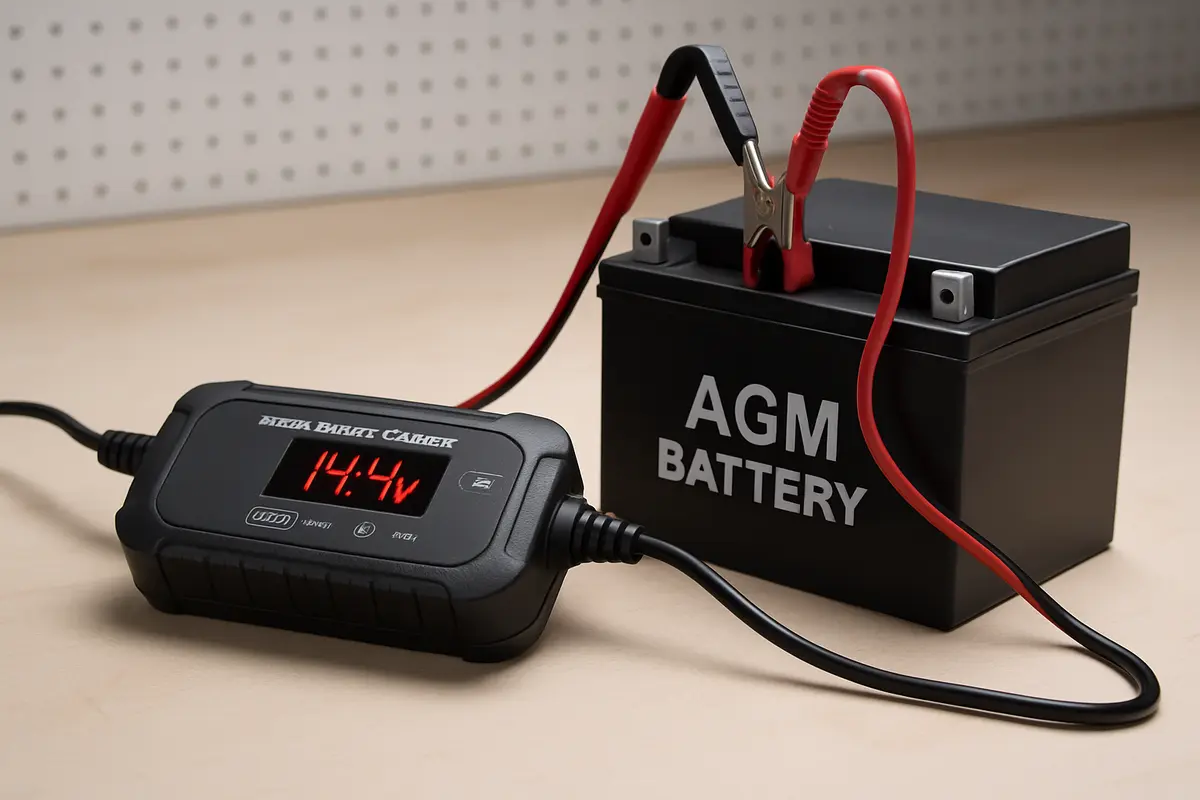
AGM Battery Charging: Why Precision Matters
AGM (Absorbed Glass Mat) batteries deliver exceptional standby performance in UPS, telecom, and emergency power systems — but only when charged correctly. Unlike flooded lead-acid batteries, AGM batteries are sealed and cannot be refilled with water. Every millivolt of overcharge accelerates irreversible electrolyte loss, while chronic undercharging causes sulfation that permanently reduces capacity.
This guide provides the complete charging reference for AGM VRLA batteries, including voltage set points, current limits, temperature derating, multi-stage charge profiles, and equipment-specific settings for UPS and telecom rectifier systems. All data is based on factory testing of the Naradex ND12 series per IEC 60896-21/22.
Charging Voltage Reference Table
The foundation of AGM battery charging is the per-cell voltage. A 12V AGM battery contains 6 cells in series, so the battery-level voltage is 6 times the per-cell value. A 2V cell equals one cell.
Critical: These voltages are specified at 25 degrees C (77 degrees F). Temperature compensation is mandatory for installations where ambient temperature deviates from 25 degrees C by more than 5 degrees C. See the temperature derating section below.
Multi-Stage Charging Profile
Professional AGM battery charging uses a three-stage or four-stage profile. Each stage serves a specific electrochemical purpose.
Stage 1: Constant Current (CC) — Bulk Charge
The charger delivers maximum current at the set limit until the battery voltage reaches the absorption voltage threshold (14.40-14.70V for 12V batteries).
Current limits by battery capacity (Naradex ND12 series):
Why the 0.25C limit matters: Exceeding 0.25C generates excessive internal heat. AGM separators have limited thermal conductivity, so heat accumulates faster than it dissipates. Internal temperatures above 50 degrees C accelerate positive grid corrosion and can trigger thermal runaway in aged batteries.
The bulk charge phase typically restores 70-80% of the battery's capacity in 2-4 hours, depending on the depth of discharge and charge current.
Stage 2: Constant Voltage (CV) — Absorption Charge
Once the battery reaches the absorption voltage (14.40-14.70V), the charger transitions to constant voltage mode. The current gradually tapers as the battery approaches full charge. This stage completes the remaining 20-30% of charging.
End-of-charge criteria: The absorption phase is complete when the charge current drops below 0.02C (2A for a 100Ah battery) and remains stable for 30 minutes. Typical duration is 3-6 hours for a deeply discharged battery.
Timer backup: Most quality chargers include a maximum absorption time limit (typically 8-12 hours) as a safety backstop. If the current has not tapered to the threshold within this time, the charger transitions to float regardless — preventing indefinite high-voltage charging.
Stage 3: Float Charge — Maintenance
After absorption completes, the charger reduces voltage to the float set point (13.50-13.80V for 12V batteries). This voltage sustains the battery at 100% state of charge without causing significant gassing or water loss.
Float current benchmarks (healthy battery at 25 degrees C):
Diagnostic value: Float current is one of the most underused battery health indicators. A healthy AGM battery at float voltage draws minimal current. If float current increases by more than 3 times the baseline value, the battery is approaching end of life — typically due to internal micro-shorts, grid corrosion, or separator dry-out.
Stage 4: Equalization Charge (Periodic, Optional)
Equalization charging applies a slightly elevated voltage (14.10-14.40V for 12V batteries) for 4-12 hours to counteract cell imbalance in multi-cell batteries. This is primarily used in large 2V cell installations where individual cell voltages can drift over time.
For 12V AGM batteries in UPS service: Equalization is generally not recommended. Modern UPS chargers do not include equalization, and the risk of overcharge damage outweighs the benefit for sealed 12V units. If individual cell voltages within a 12V block drift by more than 0.05V, the battery is likely approaching end of life and should be replaced rather than equalized.
For 2V stationary cells (NL2 series): Equalization is recommended after deep discharge events or every 6-12 months. Set the rectifier to 2.35-2.40 V/cell for 8 hours, then return to normal float.
Temperature Compensation: The Most Overlooked Setting
Temperature compensation adjusts charging voltage based on ambient temperature to maintain optimal electrochemical conditions. Without it, batteries in warm climates are chronically overcharged, and batteries in cold climates are chronically undercharged.
Compensation Coefficients
Complete Temperature-Voltage Derating Table (12V AGM)
*Source: Naradex factory accelerated life testing per IEC 60896-21/22, Arrhenius equation applied*
The Arrhenius rule of thumb: For every 10 degrees C increase in average operating temperature above 25 degrees C, AGM battery life is approximately halved. A 10-year battery at 35 degrees C becomes a 5-year battery. At 45 degrees C, it becomes a 2.5-year battery.
Implementing Temperature Compensation
Option 1: Automatic (preferred). Most quality UPS and telecom rectifiers have a temperature sensor input. Install the sensor on the battery case (mid-height, center of the string) and enable automatic temperature compensation in the charger settings.
Option 2: Manual seasonal adjustment. If your charger does not support automatic compensation, adjust the float voltage seasonally. Measure the average battery room temperature during summer and winter peaks, calculate the compensated voltage, and update the charger setting.
Option 3: Climate-controlled battery room (best practice). Maintain the battery room at 20-25 degrees C using HVAC. This eliminates the need for temperature compensation and maximizes battery life. The energy cost of cooling is typically recovered many times over through extended battery service life.
UPS Charger Settings by Brand
Most UPS systems ship with factory-default charging parameters optimized for AGM batteries. However, these defaults should be verified — especially after battery replacement or in non-standard operating conditions.
After replacing UPS batteries: Always verify the charger output voltage matches the new battery's requirements. Measure the actual voltage at the battery terminals (not just the UPS display) with a calibrated multimeter. Discrepancies of even 0.2V over months will significantly impact battery life.
Telecom Rectifier Settings (48V Systems)
Charging After Deep Discharge: Recovery Protocol
When an AGM battery has been deeply discharged (below 10.5V for 12V batteries), standard charging procedures may not recover it. Follow this recovery protocol:
Step 1: Measure open-circuit voltage (OCV). If OCV is below 10.5V but above 8.0V, recovery is possible. Below 8.0V, the battery has likely suffered irreversible sulfation.
Step 2: Apply trickle current. Start with 0.05C (5A for a 100Ah battery) until the voltage rises above 12.0V. This may take 2-12 hours depending on the depth of discharge.
Step 3: Transition to normal charging. Once the voltage reaches 12.0V, increase the current to the standard 0.15-0.25C rate and follow the normal three-stage profile.
Step 4: Verify capacity. After a full charge cycle, perform a controlled discharge test. If the battery delivers less than 80% of its rated capacity, it has suffered permanent damage and should be replaced.
Time limit: A deeply discharged AGM battery should begin recovery charging within 48-72 hours. Beyond this window, sulfation progresses rapidly and recovery becomes increasingly unlikely.
Common Charging Mistakes and Their Consequences
Related Resources
- AGM vs Gel vs Flooded Battery Comparison — How charging differs by technology - UPS Battery Replacement Guide — When and how to replace - VRLA Battery Maintenance Guide — Ongoing care best practices - AGM Battery Lifespan — Factors affecting service life - Our 12V AGM Battery Products — Naradex ND12 series specifications