
SLA vs Gel Battery: Which Is Better? Complete Comparison [2026]
SLA vs gel battery explained: gel delivers 1,500 cycles at 80% DOD vs AGM's 500. Compare cost, charging voltage, temp range & best applications. Factory test data inside.
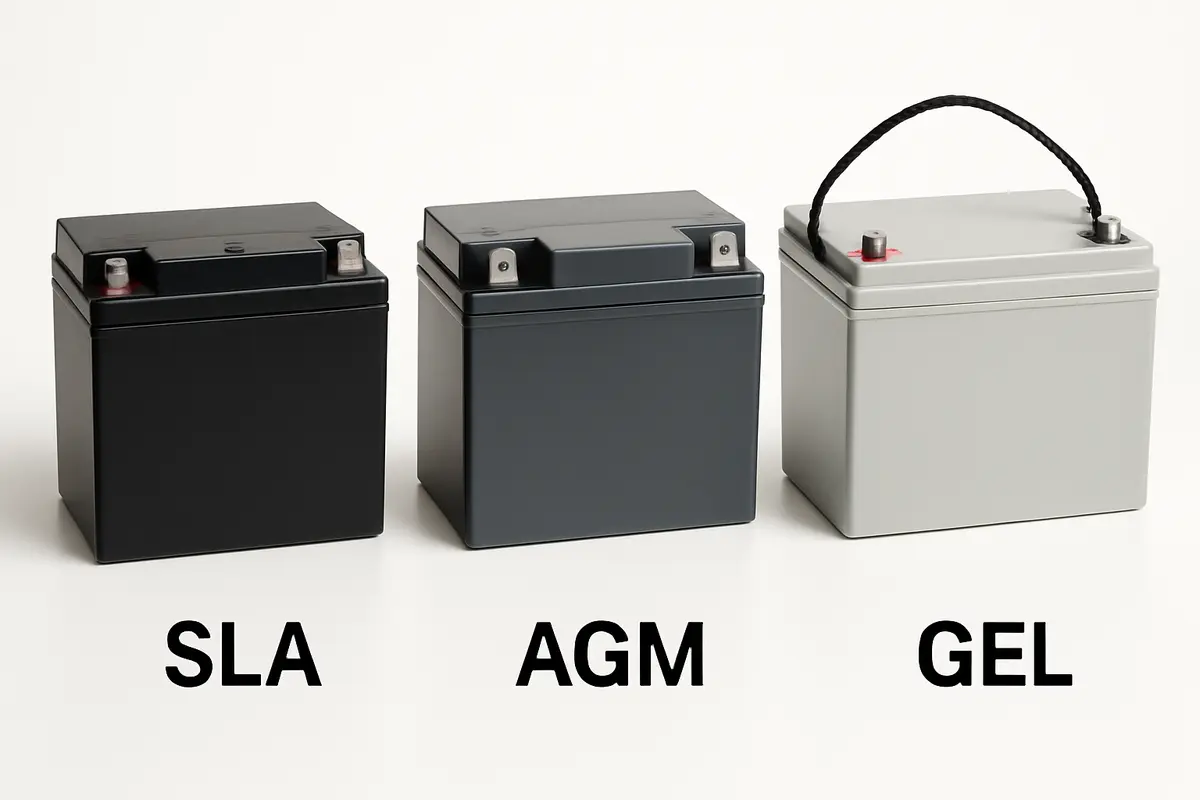
SLA vs Gel Battery: The Core Difference
SLA (Sealed Lead Acid) is the category; Gel is one of its two subtypes. When buyers compare "SLA vs Gel," they usually mean AGM-type SLA versus Gel-type SLA. The key difference: **Gel batteries use fumed silica gel electrolyte** for superior deep-cycle life (1,500+ cycles at 80% DOD), while **AGM batteries use fiberglass mat electrolyte** for lower cost and better high-rate discharge. Gel costs 30-50% more but delivers 2-3x the cycle life in daily-cycling applications like solar and electric vehicles. For standby backup (UPS, telecom), AGM is the industry standard.
Quick Answer: SLA, AGM, and Gel Are All Sealed Lead-Acid Batteries
SLA (Sealed Lead Acid) is the umbrella term for any lead-acid battery that is sealed and maintenance-free. **AGM and Gel are the two types of SLA batteries** — they differ in how the electrolyte is immobilized.
- **SLA** = Sealed Lead Acid = the category (also called VRLA, Valve Regulated Lead Acid) - **AGM** = Absorbed Glass Mat = electrolyte absorbed in fiberglass mats - **Gel** = Gelled Electrolyte = electrolyte mixed with fumed silica to form a gel
If someone asks you to buy an "SLA battery," they typically mean an AGM battery — AGM accounts for over 80% of all SLA batteries sold worldwide. For a detailed comparison of AGM against traditional flooded types, see our AGM battery vs lead acid guide. If you're ready to select a battery, check our AGM SLA battery buyer's guide.
Quick Selection Guide: Which Battery Type Do You Need?
What Is an SLA Battery?
SLA (Sealed Lead Acid) battery is a general term for any lead-acid battery that is sealed with a pressure-relief valve. Unlike traditional flooded (wet-cell) batteries, SLA batteries:
- Do not require water addition (maintenance-free) - Can be operated in any orientation (no liquid to spill) - Emit minimal gas under normal conditions (sealed with one-way valve) - Are classified as "non-spillable" for shipping (IATA/DOT exempt from hazmat in most cases)
The term **VRLA (Valve Regulated Lead Acid)** is technically more accurate — the battery is not truly "sealed" but has a pressure-relief valve that opens at 10-40 kPa to prevent explosion in case of overcharging.
AGM vs Gel: The Two Types of SLA/VRLA Batteries
AGM (Absorbed Glass Mat) Batteries
AGM batteries immobilize the electrolyte using a **fiberglass mat separator** between the plates. The mat absorbs approximately 95% of the sulfuric acid through capillary action.
Advantages of AGM: - Lower internal resistance → better high-rate discharge (ideal for UPS) - Faster recharging → accepts charge current up to 0.25C - Lower cost than gel batteries (20-30% less at equivalent capacity) - Better performance in standby/float applications
Limitations of AGM: - Less tolerant of deep cycling than gel - More sensitive to overcharging - Shorter cycle life at high depths of discharge
Gel Batteries
Gel batteries mix the sulfuric acid electrolyte with **fumed silica (SiO₂)** to create a thick, paste-like gel that fills the entire cell.
Advantages of Gel: - Superior deep cycle performance → 1,500+ cycles at 80% DOD - Better heat dissipation (gel conducts heat better than air gaps in AGM) - No acid stratification → uniform plate usage - Longer cycle life in solar/renewable energy applications
Limitations of Gel: - Higher internal resistance → less suitable for high-rate UPS discharge - Slower charging → maximum 0.15C charge current - Higher cost → 30-50% more than AGM at equivalent capacity - Sensitive to charging voltage (must not exceed 14.1V for 12V batteries)
SLA vs AGM vs Gel: Comparison Table
How to Choose: Application Guide
Choose AGM When:
- **UPS / backup power** — AGM's low internal resistance delivers more power during short, high-current discharge events - **Telecom base stations** — AGM's lower cost and reliable standby performance make it the industry standard - **Data centers** — AGM's fast recharge and high-rate capability match UPS requirements - **Emergency lighting** — AGM's long float life (5-12 years) and compact size fit building safety systems - **Fire alarm systems** — AGM meets UL and NFPA requirements for sealed, maintenance-free standby batteriesChoose Gel When:
- **Solar / renewable energy storage** — Gel's deep cycle capability (1,500+ cycles at 80% DOD) handles daily cycling - **Electric vehicles / golf carts** — Gel's tolerance for deep discharge extends service life - **Hot climates (>35°C ambient)** — Gel dissipates heat better than AGM - **Marine / offshore** — Gel's vibration resistance and deep cycle performance suit marine applications - **Cycling applications requiring maximum lifespan** — Gel costs more but delivers 2-3× the cycle life of AGM at deep DODThe Naradex Product Range
Manufacturer Pricing: AGM vs Gel (Factory Direct)
Most comparison articles skip pricing because they are written by bloggers, not manufacturers. Here is what these batteries actually cost at the factory level — data from NARADEX production lines as of October 2026:
Key insight: Gel batteries cost 40–65% more upfront, but the cost per cycle is 60% lower because Gel lasts 1,500+ cycles versus 300–500 cycles for AGM. For any application that cycles daily (solar, EV, marine), Gel pays for itself within 18 months. For standby applications that rarely discharge (UPS, telecom), AGM wins on total cost because the batteries may never reach their cycle limit before end-of-design-life replacement.
> Need factory pricing for your specific battery configuration? Request a quote from NARADEX → or view our AGM battery and OPzV Gel battery product lines.
*Last Updated: October 5, 2026 — pricing and technical data verified against NARADEX Q4 2026 production specifications.*
Common Misconceptions About SLA, AGM, and Gel Batteries
Myth 1: "SLA battery" means a specific technology SLA simply means Sealed Lead Acid — it's a category, not a specific design. When someone says "I need an SLA battery," they mean any sealed, maintenance-free lead-acid battery. AGM and Gel are both SLA types.
Myth 2: Gel batteries are always better than AGM Gel batteries outperform AGM in deep-cycle applications (1,500 vs 800 cycles at 80% DOD). But for UPS standby use (float charging, occasional discharge), AGM is superior — lower cost, faster recharge, better high-rate performance.
Myth 3: You can charge AGM and Gel batteries the same way Critical difference: AGM float voltage is 13.5–13.8V; Gel float voltage is 13.5–13.8V (similar), but Gel batteries must NEVER exceed 14.1V during bulk charging — AGM can handle up to 14.7V. Using an AGM charger on a Gel battery can permanently damage it.
Myth 4: "Maintenance-free" means you never need to check them SLA batteries don't require water refills, but they still need: float voltage verification every 6 months, impedance testing after year 3, and temperature monitoring (every 8°C above 25°C halves battery life).
Related Resources
- VRLA Battery Technology: Types & Applications — The complete VRLA family explained - AGM vs Lead Acid Battery — AGM compared to traditional flooded batteries - AGM vs Gel Battery for UPS — Detailed UPS-focused comparison - SLA Battery Buyer's Guide — How to select sealed lead acid batteries by application - How to Charge AGM Batteries — Correct charging voltages and methods - VRLA Battery Maintenance Guide — Extend your battery's life - Our 12V AGM Battery Products — View the Naradex ND12 series - OPzV Tubular Gel Batteries — For deep-cycle and solar applications - AGM Battery Lifespan: How Long Do They Last? — Detailed lifespan data by application