
AGM vs Gel Battery: UPS & Solar Comparison — Cycles & Cost [2026]
AGM vs gel battery side-by-side: cycle life, DOD tolerance, temperature range, charging voltage, cost per kWh. Manufacturer test data for UPS backup and solar energy storage. Decision matrix inside.
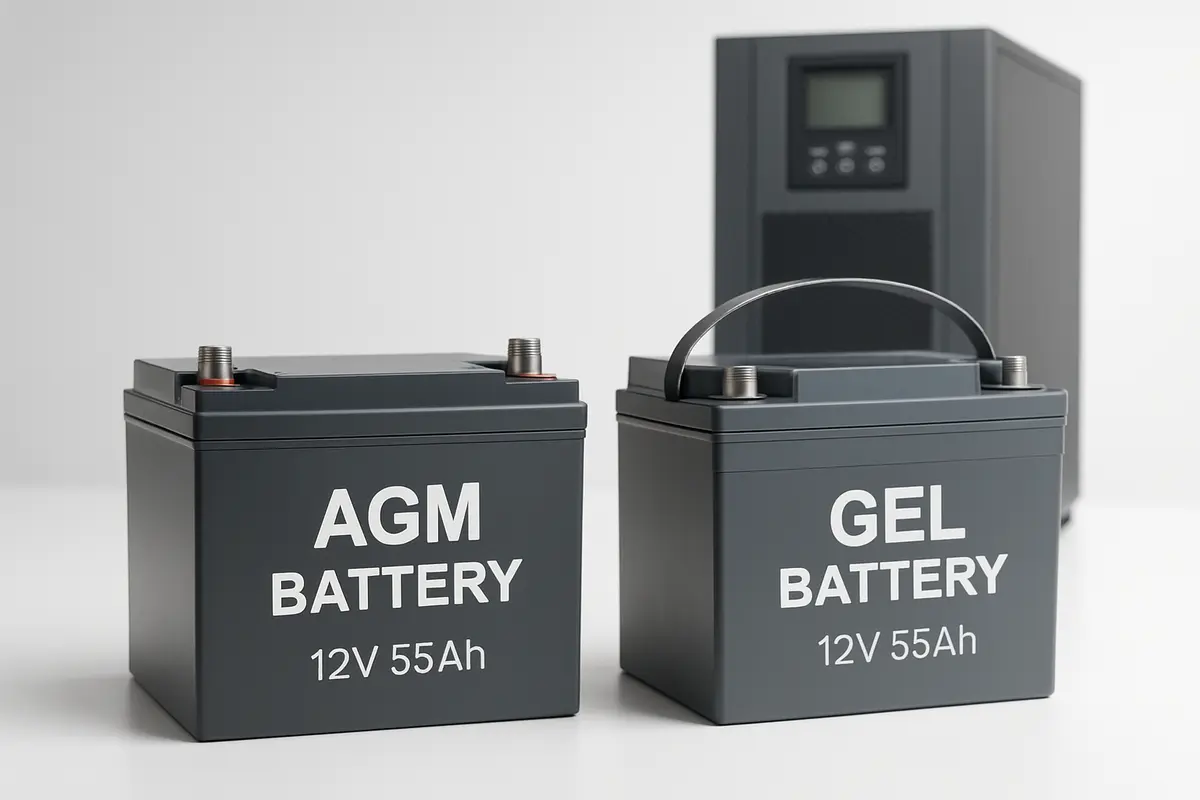
Quick Answer: AGM or Gel — Which Should You Choose?
For UPS and standby backup power: AGM wins. Lower internal resistance delivers 20-25% more power per kilogram during high-rate discharge, recharges 40% faster, and costs 20-30% less upfront. Your UPS batteries sit at float voltage 99% of the time — AGM excels here.
For solar energy storage and deep cycling: Gel wins. At 80% depth of discharge, gel batteries deliver 1,500+ cycles versus 300 for AGM. Over a 10-year solar installation, gel batteries need zero replacements while AGM needs 2-3 sets.
For telecom in hot climates (35C+): Gel wins. The gel electrolyte acts as a thermal buffer, maintaining performance at temperatures where AGM life degrades by 50% or more.
This guide provides the complete technical comparison with manufacturer test data from our Foshan factory, covering every parameter that affects your purchasing decision.
How AGM and Gel Batteries Work — The Fundamental Difference
Both AGM and gel batteries are sealed lead-acid (SLA/VRLA) technologies. They use the same electrochemistry — lead dioxide positive plates, sponge lead negative plates, and sulfuric acid electrolyte. The critical difference is how the electrolyte is immobilized.
AGM (Absorbed Glass Mat)
A fiberglass mat separator is compressed between the lead plates. The mat absorbs sulfuric acid through capillary action, holding it in place like a sponge. Approximately 5-8% of the pore space remains unfilled with acid — this void space is essential for oxygen recombination during charging (the reaction that keeps the battery sealed).
Manufacturing note: At our Foshan factory, we control the AGM compression ratio to 15-20% of the uncompressed mat thickness. Too loose (below 12%) causes uneven acid distribution. Too tight (above 25%) restricts acid flow and reduces discharge capacity. This compression tolerance is one of the quality factors that separates premium AGM from budget products.
Gel (Gelled Electrolyte)
Fumed silica (SiO2) is mixed with sulfuric acid at a ratio of approximately 5-7% silica by weight. This mixture is poured into the cells as a liquid and solidifies into a firm gel within 24-48 hours. The gel completely fills the cell cavity, eliminating all free-flowing liquid.
During initial cycling, micro-cracks form in the gel structure. These cracks create gas channels for oxygen recombination — the same function as the void space in AGM. This is why new gel batteries should be gently cycled (3-5 shallow cycles) before being put into heavy service.
OPzV (tubular gel) adds tubular positive plates — lead oxide paste is contained inside porous tubes rather than pasted onto flat grids. This prevents active material shedding during deep cycling, which is why OPzV gel batteries achieve 1,500+ cycles at 80% DOD while flat-plate gel batteries achieve only 800-1,000 cycles.
Complete Parameter Comparison Table
This table uses data from our IEC 60896-21/22 testing at 25C. All values represent the Naradex ND12 (AGM) and OPzV2 (gel) product lines.
Key takeaway from the cost-per-cycle column: At shallow discharge (50% DOD), both technologies have comparable lifetime cost. At deep discharge (80% DOD), gel is dramatically cheaper per cycle because AGM cycle life collapses at high DOD while gel maintains strong performance.
AGM vs Gel for UPS Backup Power
UPS applications have a distinctive operating profile: batteries sit at float voltage 99.5% of the time and must deliver high-rate discharge for 5-30 minutes during power outages.
Why AGM Dominates UPS Applications
1. Superior high-rate discharge performance. AGM internal resistance is 25-40% lower than gel. For a 12V 100Ah battery, the Naradex ND12-100 delivers 600A for 5 seconds — sufficient for UPS load transfer. A comparable gel battery delivers 300-400A. This means fewer battery strings needed to support the same UPS load.
2. Faster recharge. After a 15-minute outage discharge, an AGM battery recharges to 80% in 4-6 hours. A gel battery takes 8-12 hours for the same recovery. In areas with multiple daily outages, this recharge speed advantage matters.
3. Lower cost. For a standard 48V UPS system using 4 x 12V 100Ah batteries, AGM costs approximately $320-480 per battery bank versus $600-1,000 for gel. With typical 5-8 year replacement cycles in UPS service, AGM delivers the best return on investment.
4. UPS charger compatibility. Almost all commercial UPS systems ship with AGM-optimized charge settings. Using gel batteries in a UPS requires reprogramming the charger — using AGM settings on gel batteries will overcharge and permanently damage the gel electrolyte.
When Gel Makes Sense for UPS
Gel batteries are the better UPS choice in two specific scenarios:
Unstable power grids (5+ outages per day): In regions with frequent power cuts — parts of Africa, South Asia, and the Middle East — UPS batteries cycle heavily. At 2-3 deep cycles per day (60-80% DOD), gel batteries last 3-5 years while AGM may last only 1-2 years.
High ambient temperature (35C+) without HVAC: Edge data centers, outdoor telecom cabinets, and industrial UPS installations in hot climates degrade AGM batteries rapidly. At 35C, AGM design life drops from 10 years to 3-4 years. Gel maintains 8-10 years at the same temperature.
AGM vs Gel for Solar Energy Storage
Solar applications cycle batteries daily — fundamentally different from UPS standby service. This is where the AGM/gel decision becomes critical.
The Daily Solar Cycle Challenge
A typical off-grid solar system charges batteries during 4-6 hours of peak sunlight and discharges them over 12-18 hours at night. This means:
- **365 cycles per year** at the system's target DOD - **DOD typically 50-80%** depending on system sizing - **Irregular charging** — cloudy days mean partial charges, which cause sulfation in AGM batteries
Battery Life Projection for Solar
The math is clear: For solar applications at 80% DOD, AGM batteries need replacement every 10 months — making them 3-4x more expensive than gel over a 10-year period despite the lower upfront cost.
Why Gel Excels in Solar: The Stratification Factor
AGM batteries in solar applications face a problem called **acid stratification**. During cycling, heavier sulfuric acid sinks to the bottom of the cell while lighter water rises to the top. This creates:
- **Top of cell:** Dilute acid, reduced capacity, increased corrosion rate - **Bottom of cell:** Concentrated acid, sulfation risk, reduced plate life
The glass mat in AGM resists but does not eliminate stratification — especially in taller cell designs (like the ND12-150 and ND12-200 which are 210-219mm tall).
Gel electrolyte is physically immobilized in a solid matrix. Acid cannot migrate. Stratification is completely eliminated. This is the primary reason gel batteries last 2-3x longer in cycling applications.
Naradex Recommendation for Solar Systems
Charging Requirements: Getting This Wrong Kills Batteries
The #1 cause of premature battery failure is incorrect charging voltage. AGM and gel batteries require different charge settings, and using the wrong profile will destroy either type.
Charge Voltage Settings
Critical warning for solar MPPT controllers: Most MPPT charge controllers ship with a default "sealed lead-acid" profile that is optimized for AGM. If you install gel batteries, you must manually select the "gel" profile or set custom voltages. Using AGM charge settings on gel batteries (especially boost voltage above 14.4V for 12V systems) creates permanent gas pockets in the gel that cannot recombine — irreversibly reducing capacity.
Temperature Performance: The Hidden Advantage of Gel
Temperature is the single biggest external factor affecting battery life. The Arrhenius equation predicts that every 8-10C increase above 25C approximately halves battery life. But AGM and gel respond differently to heat.
Design Life at Various Temperatures
*Source: Naradex factory accelerated life testing per IEC 60896-21/22*
Why gel handles heat better: The gel electrolyte has higher thermal mass than the absorbed electrolyte in AGM. It acts as a heat sink, moderating temperature swings within the cell. Additionally, the gel structure resists drying out at elevated temperatures — AGM separators can lose moisture faster at high temperatures, leading to increased internal resistance and thermal runaway risk.
Climate Zone Recommendations
10-Year Total Cost of Ownership Comparison
Let us calculate the true cost for two common scenarios.
Scenario 1: 10 kVA UPS System (48V, Climate-Controlled Room at 25C)
Result: In a climate-controlled environment, AGM and gel have nearly identical 10-year cost. Gel provides the added benefit of zero mid-life replacement disruption.
Scenario 2: 5 kW Off-Grid Solar System (48V, Tropical Climate at 32C)
Result: In solar applications, gel batteries save 26% over 10 years despite the higher upfront cost. The savings come from dramatically fewer replacements.
Decision Matrix: Which Battery Technology to Choose
Common Mistakes When Choosing AGM vs Gel
Mistake 1: Choosing AGM for solar to save money. The upfront savings disappear within 2-3 years due to frequent replacement. Always calculate 10-year TCO.
Mistake 2: Using AGM charge settings on gel batteries. Boost voltage of 14.7V (AGM) applied to gel creates permanent gas pockets. Always verify and adjust charger settings when switching technologies.
Mistake 3: Mixing AGM and gel in the same battery string. Never do this. Different internal resistance means unequal current sharing. One battery type will be chronically over- or under-charged, leading to premature failure of the entire string.
Mistake 4: Ignoring temperature when selecting technology. A "10-year" AGM battery in a 40C environment lasts 1.5-2 years. Always apply temperature derating to your life expectancy calculations.
Mistake 5: Oversizing AGM for deep cycle applications. Some engineers oversize AGM banks to limit DOD (e.g., installing 200Ah to use only 50%). This works but costs more than correctly sized gel — and the AGM still degrades faster from partial cycling and stratification.
Conclusion
AGM and gel batteries are complementary technologies, not competitors. Each excels in specific applications:
- **AGM** is the right choice for standby backup power (UPS, telecom, emergency lighting) in climate-controlled environments where batteries rarely cycle deeply. The Naradex ND12 Series delivers 10-year design life with 800 cycles at 50% DOD.
- **Gel (OPzV)** is the right choice for deep cycling (solar, utility storage), high-temperature environments, and applications requiring 15-20+ year service life. The Naradex OPzV2 Series delivers 20+ year design life with 1,500+ cycles at 80% DOD.
Not sure which technology fits your project? Contact Naradex for a free battery technology consultation — we manufacture both AGM and OPzV gel batteries and can recommend the optimal solution for your specific application, climate, and budget.
Related Resources
- AGM vs Gel Battery for UPS: Data Center Focus — Deep dive into data center battery selection - AGM Battery Cycle Life Testing — Factory test data and methodology - SLA vs AGM vs Gel Battery Comparison — All three technologies compared - How to Charge AGM Batteries Correctly — Voltage settings for maximum life - 12V AGM Battery Products — Naradex ND12 series - OPzV Tubular Gel Battery Products — Naradex OPzV2 series